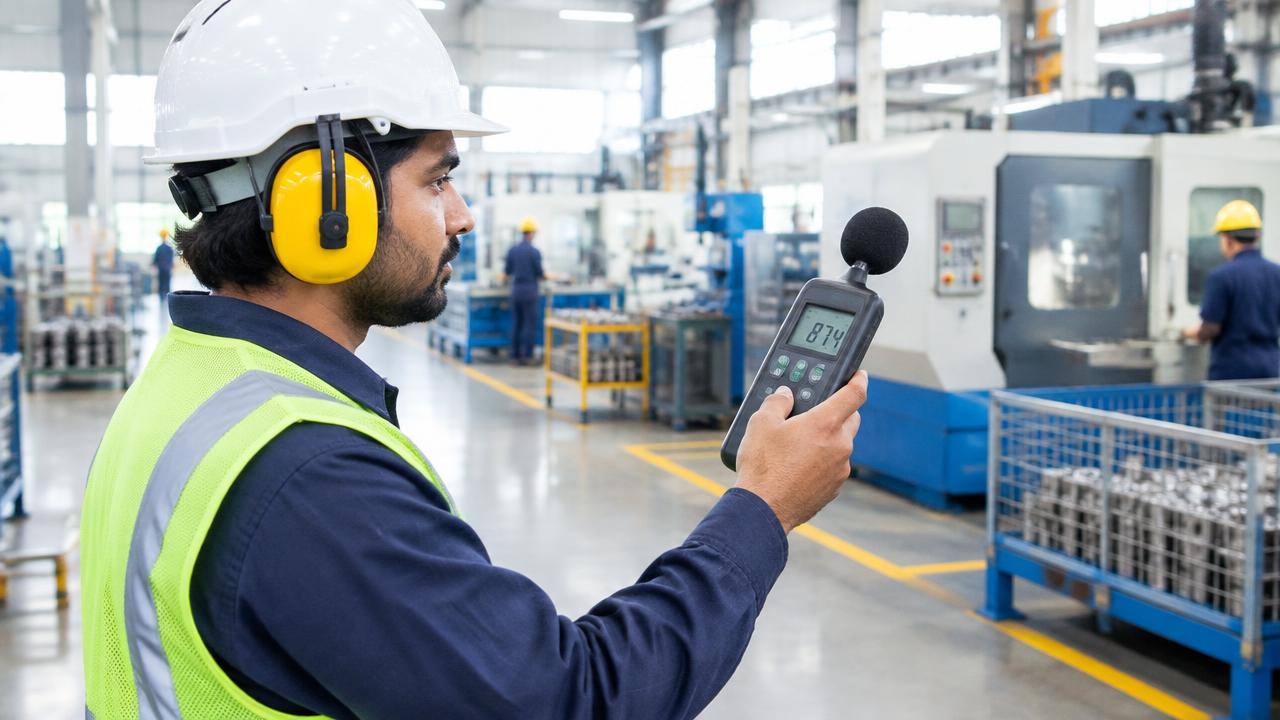
Workplace environment monitoring measures the conditions workers actually experience — noise, lighting, ventilation, heat and airborne contaminants. Its purpose is to find problems, guide controls and decide who needs health surveillance. Monitoring that ends as a filed report without action has little value. Limits and methods vary by rule and standard; use competent people and calibrated instruments.
What to monitor and why
| Parameter | Typical method | Guides health surveillance for |
|---|---|---|
| Noise | Sound level meter, personal dosimeter | Audiometry groups |
| Illumination | Lux meter at task level | Eye strain, accident risk |
| Ventilation | Air velocity, air changes, smoke tests | Respiratory and chemical exposure |
| Heat | WBGT or similar heat-stress index | Heat illness risk groups |
| Dust and fumes | Personal or area air sampling with lab analysis | Spirometry and respiratory review |
| Vapours and gases | Direct-reading instruments, sampling tubes | Chemical exposure and biological monitoring |
Monitoring plan steps
- 1List processes, tasks and shifts from the HIRA.
- 2Choose parameters and methods with a competent hygienist.
- 3Sample representative and worst-case conditions.
- 4Compare results with applicable limits and good practice.
- 5Agree controls and owners.
- 6Share results with the OHC to update surveillance groups.
- 7Repeat after process changes and at the planned interval.
For factories
Map results onto a plant layout so trends by area are visible year to year. Re-monitor after new machines, ventilation changes or new chemicals.
For construction sites
Conditions change by phase. Monitor dust during cutting and demolition, noise during piling and breaking, heat on exposed slabs, and air quality in basements and tunnels.
Legal context in India
The Occupational Safety, Health and Working Conditions Code, 2020 (OSH Code) came into force on 21 November 2025 and consolidates 13 central laws, including the Factories Act, 1948 and the Building and Other Construction Workers (BOCW) Act, 1996. Many states are still notifying their OSH Code rules, so existing State Factory Rules and BOCW State Rules remain the practical reference for many formats and norms during the transition.
Staffing levels, examination intervals, register formats and qualifications vary by state, process and workforce. Check the applicable state rules before treating any figure as a requirement. This is general information, not legal or medical advice; a registered medical practitioner decides any clinical protocol.
Plan this with Health Safety India
Health Safety India by Jainam Wellness Ltd. helps factories and construction projects plan workplace environment monitoring. Share your headcount, shifts, processes and location through the quote form, or call +91 8591983184 / 9820891087. Enquiries are accepted PAN India and local deployment is confirmed per site. Ambulance services are available in Mumbai and Pune only; in an emergency call 108 or 112.
Frequently asked questions
- How often should workplace monitoring be done?
- As required by applicable rules, and at a risk-based interval set by a competent person, plus after changes.
- Who can do the monitoring?
- Competent persons or laboratories with calibrated equipment; check any accreditation the rules require.
- Is area monitoring enough?
- Area results help, but personal sampling better reflects what a worker breathes or hears.
- How does monitoring link to medicals?
- It identifies exposed groups and helps the doctor decide surveillance tests.
- What if results exceed limits?
- Act promptly with controls, interim PPE and re-monitoring, and inform the OHC.
Talk to our occupational health and safety team
Health Safety India by Jainam Wellness Limited — onsite OHCs, safety audits, safety training, fire safety and environmental audits for PAN India enquiries; ambulances are Mumbai and Pune only. Call +91 8591983184 / 9820891087 or write to info@planmyhealth.in.
Explore the related occupational health serviceSources
- Ministry of Labour & Employment — labour codes
- Central Pollution Control Board
- ICMR-National Institute of Occupational Health
- NIOSH (CDC) — workplace safety and health
General information, not legal or medical advice. A registered medical practitioner decides any examination protocol, and applicable rules vary by state and during the OSH Code transition.
Related workplace health and safety services
Related reading
Audiometry and Noise-Induced Hearing Loss Screening in Factories
Read Occupational HealthSpirometry and Lung Function Testing for Dust-Exposed Workers
Read Environment & HealthEnvironmental factors influencing workman health in India
Read Occupational HealthOHC Vendor RFP & SLA Checklist for Factories and Construction Projects in India
Read