Service
Factory Medical Checkup in India: Pre-Employment & Annual Health Checkup for Workers
A pre-employment medical examination assesses health in relation to a defined job, rather than searching for reasons to reject a candidate. A suitable programme combines job information, relevant clinical assessment and proportionate investigations, with confidential handling of findings and clear work-related recommendations.
Summary
A pre-employment medical examination assesses health in relation to a defined job, rather than searching for reasons to reject a candidate. A suitable programme combines job information, relevant clinical assessment and proportionate investigations, with confidential handling of findings and clear work-related recommendations.
Who needs it
- Factories recruiting workers into roles involving machinery, manual handling, heat, dust, chemicals, noise or other identified occupational exposures.
- Employers introducing a consistent placement process across direct recruits and contract workers without applying unrelated tests to every person.
- Businesses appointing staff to safety-sensitive duties where a defined health limitation could affect the worker or other people.
- Organisations replacing generic health packages with examinations based on actual job demands, exposure groups and medical judgement.
- HR and occupational health teams needing a documented baseline for future surveillance without treating baseline findings as proof of occupational causation.
- Sites moving existing employees into materially different tasks, where a pre-placement assessment may be more appropriate than repeating a recruitment package.
What's included
- Review of job descriptions, physical demands, proposed exposures and any safety-sensitive tasks before the examination protocol is finalised.
- A medical history and relevant clinical examination conducted through an appropriate healthcare team, with a route for doctor review.
- Selection of investigations according to the role and clinical need, rather than an assumption that more tests always mean better assessment.
- Coordination of appointment schedules, identity checks, worker instructions and practical arrangements for onsite or suitable offsite examination delivery.
- Review of available reports by the responsible doctor, including clarification or referral when an isolated result cannot support a reliable fitness decision.
- A job-related fitness outcome with relevant restrictions, further assessment requirements or review timing where clinically appropriate.
- Confidential clinical records and controlled communication so recruitment teams receive necessary work advice rather than unrestricted personal health information.
Start with the job rather than a test package
A pre-employment medical examination is most useful when the clinician understands the proposed work. A forklift operator, laboratory technician and office administrator do not have identical demands. Relevant information may include visual tasks, load handling, shift work, respirator requirements, heat exposure and the consequences of sudden incapacity.
Routine blood tests cannot answer every fitness question. Conversely, an examination should not omit a relevant assessment simply because it is absent from a standard package. The protocol should be proportionate and clinically justified, with special investigations or specialist referrals used only when they add meaningful information.
Use fair and clinically defensible fitness decisions
A diagnosis alone does not establish that a person cannot perform a job. The doctor should consider functional ability, treatment, likely exposure and possible adjustments. Fitness may be appropriate with a defined restriction or review, and a temporary deferral may be more accurate than a permanent adverse conclusion.
Candidates should understand why information is being collected, who will receive it and how they can obtain their own findings. Employers should avoid requesting unrelated sensitive testing or using broad consent wording to justify unlimited disclosure. Clinical independence and respectful communication are essential to a credible recruitment process.
Place examinations in the current legal context
The Occupational Safety, Health and Working Conditions Code, 2020 has been in force since 21 November 2025 with the other three labour codes and consolidates 13 central laws, including the Factories Act, 1948. State Factories Rules remain legacy references until relevant state OSH rules are notified; applicable examination requirements need location-specific confirmation.
The phrase 'Factories Act medical examination' is still used in enquiries, but it should not imply that the former Act is the sole current framework. A baseline examination also does not discharge ongoing surveillance responsibilities. Workers whose exposure continues may need periodic or hazard-specific review under the applicable arrangements.
How it works
- 01Map jobs and risksGroup roles by duties, exposures and safety implications. Confirm what the employer needs to know and remove screening requests without a clear work-related purpose.
- 02Agree the protocolThe medical team selects the assessment components and identifies any preparation requirements. Confirm location, scheduling, consent information and the process for additional findings.
- 03Conduct the assessmentVerify identity, explain the examination and collect relevant history. Complete the clinical assessment and selected tests with attention to privacy and test quality.
- 04Make a clinical decisionReview results in the context of the actual job. Seek clarification or specialist advice where needed instead of making a decision from one abnormal value.
- 05Communicate and follow upProvide the appropriate fitness outcome to authorised contacts and explain findings to the candidate. Record any restrictions, referral advice and review arrangements.
Deliverables & records
- A role-based examination matrix explaining the assessment components for each job group and the information needed to keep it current.
- Candidate preparation and appointment instructions, including any test-specific requirements confirmed by the clinical team rather than assumed for everyone.
- Individual clinical examination records and investigation reports maintained through a defined, confidential recordkeeping process.
- A doctor-reviewed fitness opinion addressing the proposed role, with relevant work limitations or pending assessment clearly distinguished.
- A referral and review list for unresolved findings, with appropriate separation between clinical detail and the status shared with recruitment teams.
- An anonymised programme summary identifying completion status, operational issues and opportunities to improve placement arrangements without ranking candidates by diagnosis.
Employee medical checkups: buyer questions
What is included in a factory medical checkup in India?
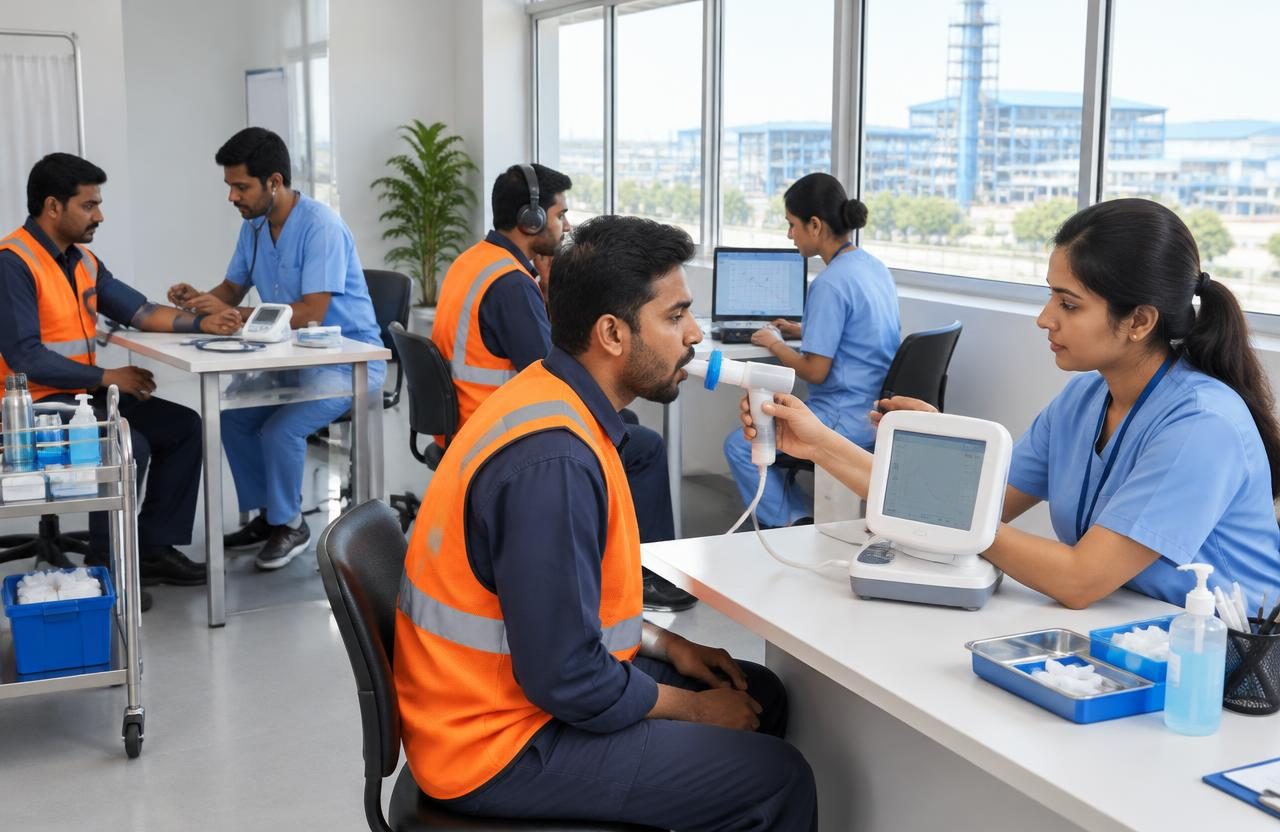
A doctor examination with BP, BMI, vision, blood and urine tests, plus hazard-based tests such as audiometry, spirometry, chest X-ray or blood lead, and a fitness certificate.
Can you run annual health checkups for employees onsite?
Yes. We run onsite camps for pre-employment, annual and periodic employee health checkups with confidential individual reports and a management summary.
Which tests are compulsory for every recruit?
There is no single test panel that can responsibly be described as compulsory for every recruit in every workplace. Requirements depend on the role, exposures and applicable rules. The medical team should explain the reason for each selected component and identify where legal confirmation is needed.
Can examinations be conducted at our factory?
Onsite delivery may be suitable if privacy, examination facilities, equipment and clinical quality requirements can be met. Some investigations may require an appropriate external facility. The delivery plan should identify what happens onsite, what is referred out and how reports are reviewed together.
Does an abnormal result mean the candidate is unfit?
Not automatically. Results need clinical interpretation, sometimes repeat testing or specialist advice. The key question is whether the finding affects the defined work and whether a suitable adjustment or treatment plan addresses the concern. Avoid decisions based only on an automated laboratory flag.
Can an existing employee use this service?
Yes, a pre-placement assessment may be appropriate before transfer to a different role or exposure. Its purpose should be stated accurately. It should not be confused with a periodic examination, a return-to-work assessment or a general wellness check.
What should HR receive after the examination?
HR should receive the agreed fitness outcome, relevant work restrictions and any necessary review status. Detailed history, diagnoses and investigation reports should remain in appropriate clinical channels unless there is a valid basis for sharing them. The candidate should receive suitable clinical explanations.
How are workplace medical tests selected?
Tests are selected using job demands, exposure history, individual clinical needs and applicable requirements. The examining doctor or registered medical practitioner decides the protocol; a standard package may not address every hazard.
Are pre-employment and periodic examinations interchangeable?
A pre-employment examination considers health in relation to the proposed role. Periodic examinations review relevant changes over time and should reflect ongoing exposure and applicable state rules.
Related guidance: Are pre-employment and periodic examinations interchangeable?How often should workers have examinations?
Check the applicable state rules and any hazard-specific obligations rather than assuming one interval for everyone. The examining doctor may advise additional review based on exposure, symptoms or clinical findings.
Related guidance: How often should workers have examinations?Health Safety India by Jainam Wellness Limited — scope, role eligibility and local availability are confirmed for your site.
Related industries
Related services
Training and safety staffing support
Combine this with trained first aid and CPR responders, task-based safety training and, where the role requires it, a qualified safety officer on contract.
Factory Medical Checkup in India by state
Get a quote for factory medical checkup in india
Health Safety India by Jainam Wellness Limited