Service
Periodic Medical Examination for Factory Workers
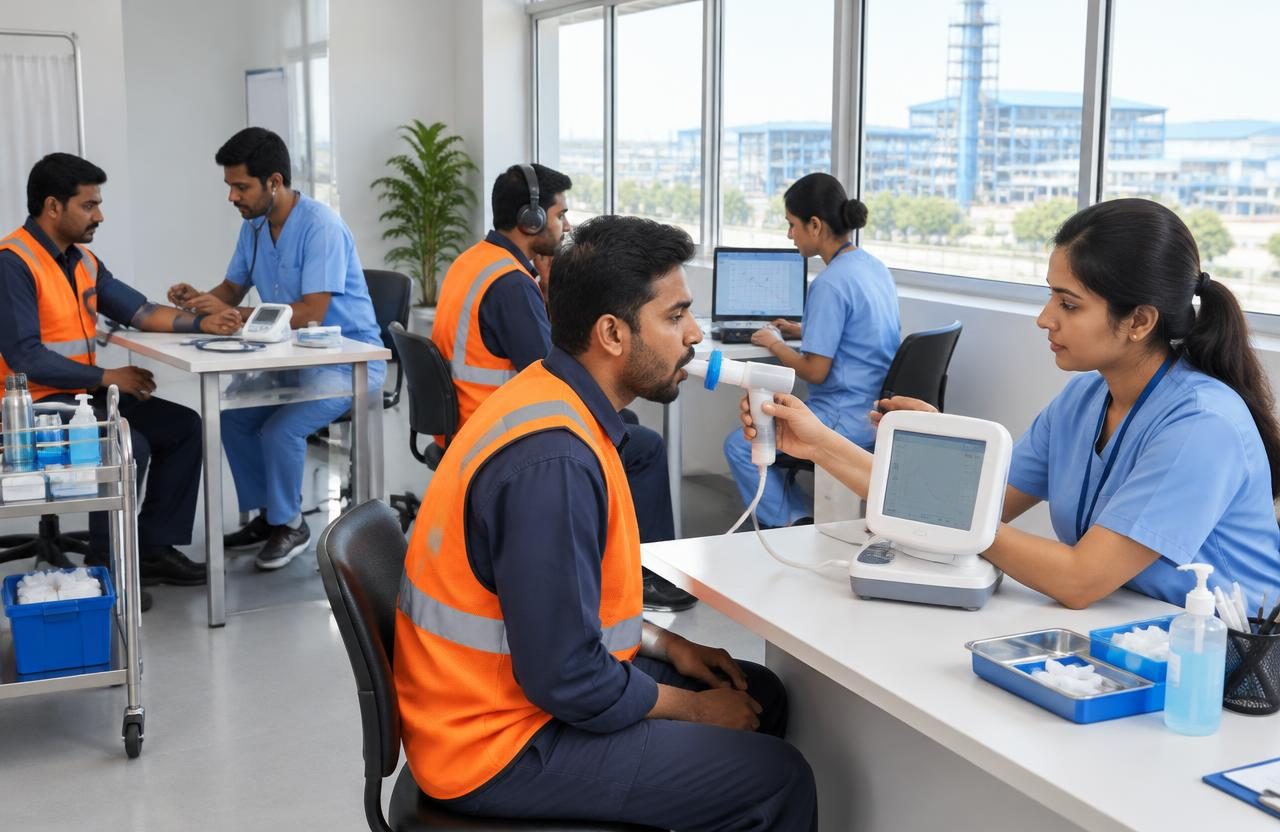
A periodic medical examination for factory workers reviews health over time in relation to work and exposure. A sound programme combines an accurate worker roster, risk-based examination protocols, clinical interpretation and follow-up, rather than treating completion of a yearly camp as the entire objective.
Summary
A periodic medical examination for factory workers reviews health over time in relation to work and exposure. A sound programme combines an accurate worker roster, risk-based examination protocols, clinical interpretation and follow-up, rather than treating completion of a yearly camp as the entire objective.
Who needs it
- Factories planning repeat medical examinations for workers exposed to noise, dust, chemicals, heat, physical strain or other identified hazards.
- Employers seeking better continuity between previous examination results, current work assignments and the next cycle of occupational health review.
- Multi-shift plants where appointment planning must include night workers, contractors, absentees and employees temporarily working in another department.
- Sites holding large volumes of medical reports but lacking a reliable system for doctor review, referral closure and work-related recommendations.
- Organisations standardising medical programmes across locations while retaining protocols suited to each site's processes and applicable state requirements.
- Management teams needing anonymised health trends to support exposure control, work design and targeted prevention without accessing individual clinical files.
What's included
- Review of workforce lists, work locations, exposure groups, previous examination coverage and the information available from earlier medical assessments.
- A medical examination protocol selected by occupational risk, clinical judgement and applicable requirements rather than by a uniform package alone.
- Scheduling and communication arrangements covering shifts, worker preparation, private assessment space and a practical route for missed appointments.
- Relevant medical history updates, clinical examination and selected investigations delivered through an appropriate healthcare team.
- Doctor review of results alongside prior findings where available, with attention to meaningful change rather than isolated abnormal flags.
- Fitness recommendations, confidential communication of findings and referral advice for workers needing treatment or further assessment.
- Programme reporting that distinguishes completed examinations, pending clinical reviews, referrals and unresolved actions requiring coordination.
Periodic examination is a continuing programme
A camp is a delivery method, not a complete occupational health system. The programme begins with knowing who needs examination and why, and continues until results have been reviewed and necessary actions communicated. Reports that remain unread or referrals that disappear after the camp limit the value of screening.
Comparison over time can be helpful only when worker identity, job history and testing methods are sufficiently consistent. Transfers matter: a person may move from a low-exposure role into a noisy or dusty process between examination cycles. The protocol should respond to that change rather than wait automatically for the next calendar event.
Separate general wellness from exposure surveillance
General health checks can identify concerns such as blood pressure or metabolic risk, but they do not automatically address occupational exposures. Audiometry, respiratory assessment or biological monitoring should be considered where justified by the work and applicable requirements. These assessments need suitable methods and clinical interpretation, not merely inclusion in a brochure.
The same principle prevents unnecessary testing. Repeated investigations without a clear question can create avoidable anxiety and follow-up burden. An occupational physician should help select a proportionate protocol and explain how results will affect care, work advice or the review of workplace controls.
Check the legal basis and examination frequency
The Occupational Safety, Health and Working Conditions Code, 2020 has been in force since 21 November 2025 alongside the other three labour codes. It consolidates 13 central laws, including the Factories Act, 1948. State Factories Rules remain legacy references until relevant state OSH rules are notified, and the applicable examination arrangements require state-specific review.
Searches for 'Factories Act medical examination' often reflect older terminology. Current proposals should explain the transition and avoid presenting one examination interval as universal. Frequency may depend on the process, exposure, worker circumstances and applicable requirements. New symptoms or a significant exposure incident may require assessment before the routine date.
How it works
- 01Reconcile the worker rosterConfirm departments, tasks, exposure groups and the population due for review. Identify joiners, transfers, contract workers and people missed in the previous cycle.
- 02Set the examination planReview hazards, previous findings and applicable requirements. Agree examination components, frequency, clinical responsibilities and the process for additional investigations.
- 03Deliver across shiftsOrganise appointments and worker communication around operations without compromising privacy or assessment quality. Maintain a clear list of absentees and incomplete examinations.
- 04Review and adviseThe doctor interprets findings, compares relevant earlier results and issues appropriate work advice. Workers receive understandable explanations and referral instructions where needed.
- 05Close actions and learnTrack pending assessments and analyse anonymised patterns. Share prevention priorities with authorised management contacts and carry unresolved issues into the next review cycle.
Deliverables & records
- A reconciled coverage register separating workers examined, absent, partially assessed and awaiting clinical review, without publicly displaying medical findings.
- An exposure-linked examination matrix identifying selected assessments, review intervals and the assumptions requiring confirmation by the responsible medical team.
- Individual examination records and reports organised to support appropriate comparison across successive assessments and changes in work assignment.
- Doctor-reviewed fitness outcomes with relevant restrictions, further assessment needs and review timing communicated through agreed confidential channels.
- A follow-up tracker for referrals and incomplete assessments, with responsibility for coordination distinguished from responsibility for clinical decisions.
- An anonymised programme report highlighting coverage gaps, health trends and recommended prevention discussions without claiming that screening proves disease causation.
Employee medical checkups: buyer questions
Is an annual examination sufficient for every worker?
Not necessarily. The appropriate interval depends on applicable requirements, exposure and clinical judgement. Some situations need closer review, while other assessments may follow a different schedule. A single annual camp should not be described as satisfying every obligation for all roles and processes.
Can our previous health reports be used?
Yes, when the records are reliable, relevant and available through an appropriate confidential process. Earlier findings can support trend review, but changes in laboratories, equipment or methods may affect comparison. The doctor should decide what can be meaningfully interpreted.
What happens when a worker misses the camp?
The coverage register should identify the missed examination and trigger an agreed catch-up arrangement. Depending on clinical and operational needs, this may involve another onsite session or an appropriate external facility. Absence should not be recorded as completion or silently removed from the denominator.
Can management receive department-wise findings?
Aggregated reporting can support prevention if it avoids identifying individuals, especially in small groups. Management should receive actionable trends and work-related recommendations rather than unrestricted medical reports. Clinical information remains subject to appropriate access controls and a valid basis for disclosure.
Does a completed examination prove the workplace is safe?
No. Medical findings are one source of information and cannot replace exposure assessment or engineering controls. Normal results do not prove that exposure is acceptable. Abnormal findings also require clinical investigation before conclusions are drawn about their relationship to work.
How are workplace medical tests selected?
Tests are selected using job demands, exposure history, individual clinical needs and applicable requirements. The examining doctor or registered medical practitioner decides the protocol; a standard package may not address every hazard.
Are pre-employment and periodic examinations interchangeable?
A pre-employment examination considers health in relation to the proposed role. Periodic examinations review relevant changes over time and should reflect ongoing exposure and applicable state rules.
Related guidance: Are pre-employment and periodic examinations interchangeable?How often should workers have examinations?
Check the applicable state rules and any hazard-specific obligations rather than assuming one interval for everyone. The examining doctor may advise additional review based on exposure, symptoms or clinical findings.
Related guidance: How often should workers have examinations?Does a checkup automatically establish fitness?
Completing tests alone does not establish fitness for every task. The examining doctor interprets findings alongside job demands and may recommend restrictions, further assessment or review.
What should workers know before a medical camp?
Explain the purpose, consent process, privacy arrangements and how results will be shared. Provide preparation instructions only as directed by the clinical team, including whether any selected test requires fasting.
Health Safety India by Jainam Wellness Limited — scope, role eligibility and local availability are confirmed for your site.
Related industries
Related services
- Factory Medical Checkup in India: Pre-Employment & Annual Health Checkup for Workers
- Hazard-Specific Health Surveillance for Industrial Workers
- Factory Medical Officer (FMO) & Industrial Doctor in India
- Occupational Health Centre (OHC) in India: Setup & Management for Factories
- Corporate Health Checkup Programmes for Employees
Training and safety staffing support
Combine this with trained first aid and CPR responders, task-based safety training and, where the role requires it, a qualified safety officer on contract.
Periodic Medical Examination for Factory Workers by state
Get a quote for periodic medical examination for factory workers
Health Safety India by Jainam Wellness Limited