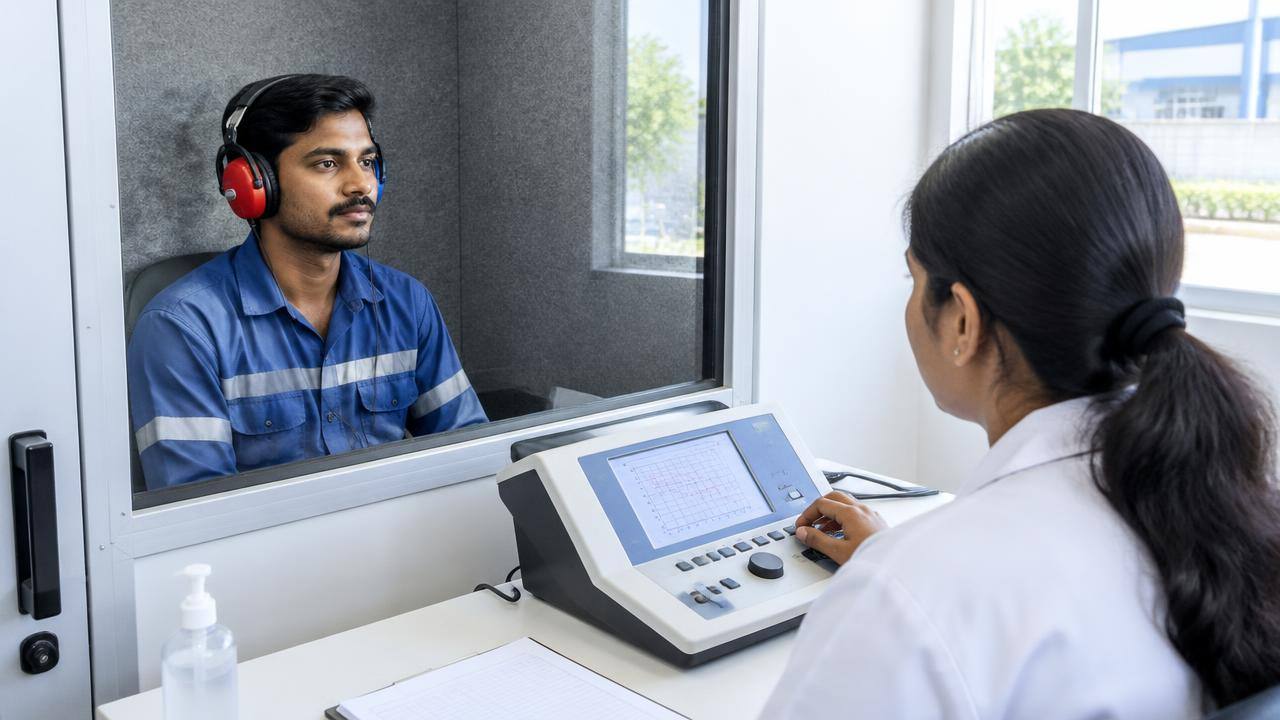
Noise-induced hearing loss develops slowly, is usually permanent and is preventable. Audiometry is the main health surveillance tool in a hearing conservation programme: it records each worker's hearing at the start and checks for change over time. It only works when it is linked to noise measurement and real noise control. The examining doctor (a registered medical practitioner) decides the final protocol, intervals and fitness opinion.
Hearing conservation in five parts
| Part | What it involves |
|---|---|
| Noise assessment | Measure noise at tasks and, where needed, personal dose |
| Noise control | Quieter machines, enclosures, maintenance, distance |
| Hearing protection | Right protector, fit, training and supervision |
| Audiometry | Baseline and periodic hearing tests for exposed workers |
| Review | Act on hearing changes and re-check controls |
Running good-quality audiometry
- 1Identify exposed groups from the noise survey.
- 2Do a baseline before or soon after placement.
- 3Ask workers to avoid loud noise before the test, as the tester advises.
- 4Use a quiet booth or room and a calibrated audiometer.
- 5Have results reviewed by a doctor or audiologist and compared with baseline.
- 6Explain results to each worker and refer where needed.
- 7Feed group trends back to engineering and safety teams.
For factories
Press shops, forging, foundries, textile looms, compressors and generator rooms are typical noisy areas. Link each worker's audiogram to the noise survey for their area and update when machines change.
For construction sites
Breakers, piling, cutting and concrete equipment create high but variable noise. Mobile audiometry at site camps can test batches; hearing protection must be compatible with helmets and communication needs.
When hearing changes
- Confirm with a repeat test
- Check protector fit and use
- Review noise controls in the area
- Refer for clinical evaluation where indicated
- Record and, where rules require, notify suspected occupational disease
Legal context in India
The Occupational Safety, Health and Working Conditions Code, 2020 (OSH Code) came into force on 21 November 2025 and consolidates 13 central laws, including the Factories Act, 1948 and the Building and Other Construction Workers (BOCW) Act, 1996. Many states are still notifying their OSH Code rules, so existing State Factory Rules and BOCW State Rules remain the practical reference for many formats and norms during the transition.
Staffing levels, examination intervals, register formats and qualifications vary by state, process and workforce. Check the applicable state rules before treating any figure as a requirement. This is general information, not legal or medical advice; a registered medical practitioner decides any clinical protocol.
Plan this with Health Safety India
Health Safety India by Jainam Wellness Ltd. helps factories and construction projects plan audiometry and hearing conservation. Share your headcount, shifts, processes and location through the quote form, or call +91 8591983184 / 9820891087. Enquiries are accepted PAN India and local deployment is confirmed per site. Ambulance services are available in Mumbai and Pune only; in an emergency call 108 or 112.
Frequently asked questions
- Who needs audiometry?
- Workers whose assessed noise exposure is significant, as decided with the doctor using the noise survey.
- How often should audiometry be repeated?
- At the interval the doctor or applicable rules set; there is no single interval for every site.
- Can audiometry be done onsite?
- Yes, in a quiet booth or room with calibrated equipment and trained staff.
- Do earplugs mean we don't need noise control?
- No. Engineering and administrative controls come first; protectors are the last line.
- Is noise-induced hearing loss reversible?
- It is usually permanent, which is why early detection and prevention matter.
Talk to our occupational health and safety team
Health Safety India by Jainam Wellness Limited — onsite OHCs, safety audits, safety training, fire safety and environmental audits for PAN India enquiries; ambulances are Mumbai and Pune only. Call +91 8591983184 / 9820891087 or write to info@planmyhealth.in.
Explore the related occupational health serviceSources
- Ministry of Labour & Employment — labour codes
- ICMR-National Institute of Occupational Health
- NIOSH (CDC) — workplace safety and health
- WHO — occupational health
General information, not legal or medical advice. A registered medical practitioner decides any examination protocol, and applicable rules vary by state and during the OSH Code transition.
Related workplace health and safety services
Related reading
Spirometry and Lung Function Testing for Dust-Exposed Workers
Read Environment & HealthWorkplace Environment Monitoring: Noise, Light, Ventilation, Heat and Air Quality
Read Occupational HealthHazardous process industries: health surveillance checklist
Read Occupational HealthOHC Vendor RFP & SLA Checklist for Factories and Construction Projects in India
Read