Service
Corporate Health Checkup Programmes for Employees
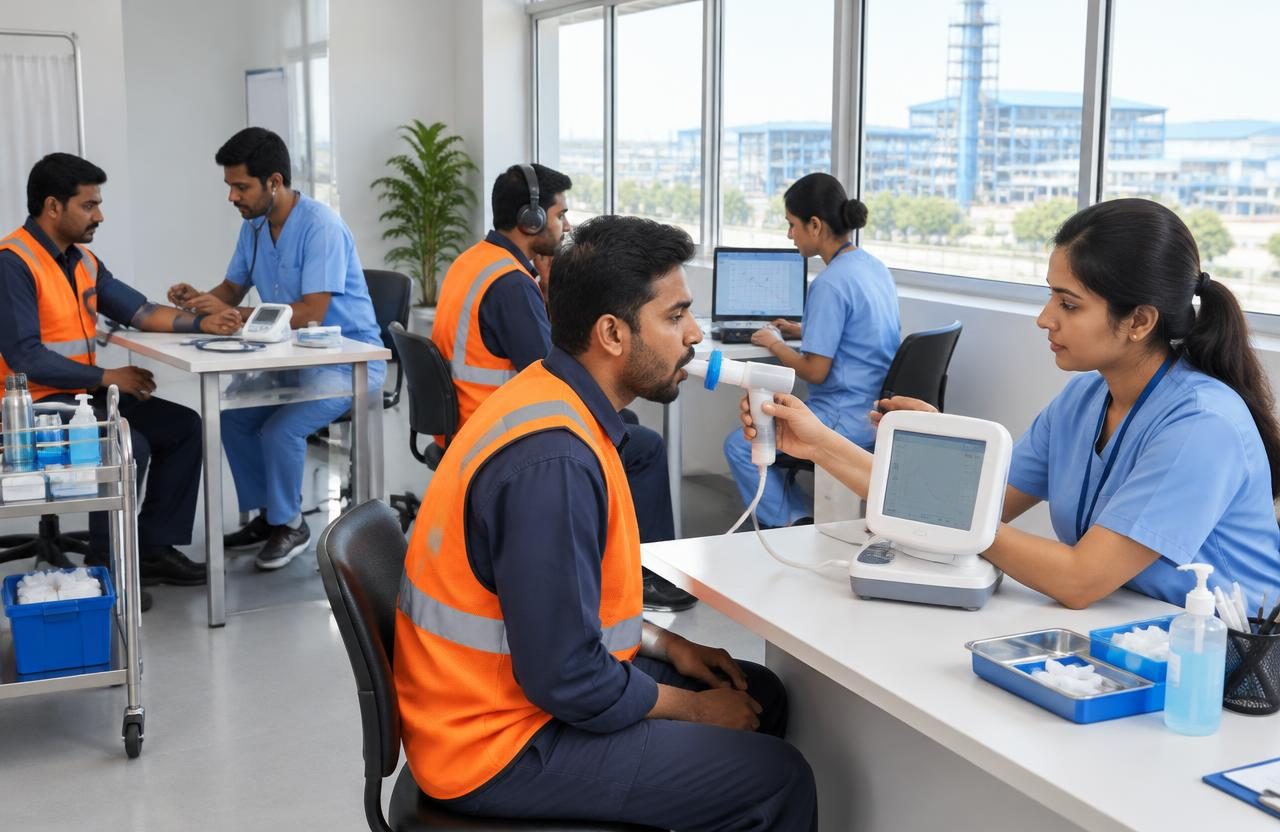
A corporate health checkup should help employees understand relevant health findings and access appropriate follow-up, rather than simply produce a large set of test reports. Health Safety India by Jainam Wellness Ltd. supports programme planning around workforce needs, clinical appropriateness, informed participation and confidential handling of individual health information.
Summary
A corporate health checkup should help employees understand relevant health findings and access appropriate follow-up, rather than simply produce a large set of test reports. Health Safety India by Jainam Wellness Ltd. supports programme planning around workforce needs, clinical appropriateness, informed participation and confidential handling of individual health information.
Who needs it
- Corporate offices and IT employers seeking a structured employee screening programme with clear communication, practical scheduling and confidential individual reporting.
- Organisations with dispersed teams that need a consistent programme framework while accommodating different locations, service providers and employee access needs.
- Employers reviewing an existing annual package because test selection, clinical interpretation or follow-up arrangements have not been clearly defined.
- Businesses introducing preventive health benefits that want to distinguish voluntary wellness screening from occupationally required medical examinations.
- Human resources and wellbeing teams seeking aggregated insights for programme planning without receiving unnecessary individual diagnoses or raw medical reports.
- Employers supporting shift-based or mixed office and operational workforces whose health needs may require different assessment pathways rather than one universal package.
What's included
- Programme scoping with the employer to understand workforce characteristics, accessibility needs, previous experience and the intended purpose of screening.
- Clinician-guided review of proposed assessments and investigations, considering relevance, limitations and the need to avoid indiscriminate testing.
- Employee communication explaining participation, preparation instructions, consent, result access, privacy arrangements and what the programme does not provide.
- Coordination of on-site or partner-facility logistics, including appointment flow, private consultation space and appropriate arrangements for sample collection.
- Defined clinical review and communication pathways so that test results are interpreted rather than distributed without context or advice.
- A referral and follow-up framework for findings requiring further evaluation, with urgent concerns directed through an appropriate clinical escalation process.
- Aggregated organisational reporting where suitable, using confidentiality safeguards and avoiding small-group reporting that could reveal individual health information.
Choose useful screening rather than the longest package
A corporate health checkup should have a defined purpose and clinically appropriate content. Age, symptoms, medical history and individual risk factors can influence what is useful. A fixed list of investigations should not be presented as equally beneficial for every employee, and additional tests should not be promoted simply because they increase package size.
Screening can produce false-positive or false-negative results and does not replace a medical consultation when someone is unwell. Employees should understand that a normal report is not a guarantee of good health. Qualified clinicians should guide interpretation and advise when a finding needs confirmation, monitoring or a different assessment rather than immediate assumptions about disease.
Protect confidentiality and informed participation
Employees need to know what information is collected, who can access it and how results will be communicated. Participation arrangements should be clear, especially when a voluntary wellbeing programme is offered alongside employment-related examinations. Clinical consultations and sample collection should take place in suitable conditions that protect privacy and dignity.
Employers generally need programme-level information for planning, not unrestricted access to individual medical histories. Use appropriately aggregated reporting and avoid breakdowns that make individuals identifiable in small teams. Where a separate occupational fitness opinion is legitimately required, communicate only the necessary conclusion or work-related advice through the appropriate process rather than circulating the underlying medical record.
Separate wellness screening from occupational surveillance
A corporate package does not automatically meet the requirements of pre-employment examinations, periodic medical examinations or hazard-specific health surveillance. Employees exposed to workplace hazards may need a separate occupational health assessment based on their actual work. General blood tests cannot substitute for a properly designed exposure-related surveillance programme.
Where occupational requirements apply, review the OSH Code, 2020, in force since 21 November 2025, and relevant notifications. State Factories Rules and State BOCW Rules remain legacy references until relevant state OSH rules are notified; applicable Shops & Establishments Acts may also be relevant to offices. Follow-up matters equally: a screening event without clear advice or referral can leave employees uncertain about what to do next.
How it works
- 01Define programme goalsClarify whether the objective is preventive screening, benefit delivery or a separate occupational assessment. Agree population coverage, exclusions and measures of programme completion.
- 02Review the clinical scopeHave qualified clinicians assess the proposed questionnaire, examinations and tests. Explain relevant limitations and identify assessments that need individual clinical judgement.
- 03Prepare participation and logisticsIssue clear employee information, confirm consent and organise appointments, privacy, accessibility and collection arrangements with the selected service providers.
- 04Screen and communicate resultsConduct the agreed activities and arrange clinical interpretation. Give employees clear instructions for accessing reports and seeking advice about findings.
- 05Support follow-up and reviewTrack agreed administrative completion measures and provide suitably aggregated insights. Review employee feedback and programme gaps without disclosing unnecessary personal medical details.
Deliverables & records
- A programme brief describing the target population, clinical scope, delivery model, exclusions and responsibilities of the employer and service providers.
- Employee information and preparation materials covering appointments, participation, consent, privacy, result access and the limits of screening.
- A coordinated schedule and operational checklist addressing site readiness, private spaces, sample collection arrangements and participant flow.
- Individual reports delivered through an agreed confidential pathway, with clinical interpretation and follow-up advice appropriate to the service scope.
- A referral and escalation framework identifying how findings are communicated and where employees can seek further clinical assessment.
- An aggregated programme summary where appropriate, distinguishing attendance and screening observations from diagnosis, outcome claims or individual fitness conclusions.
Employee medical checkups: buyer questions
Is an annual corporate health checkup mandatory for everyone?
Do not assume a universal requirement. Applicability depends on the establishment, worker category, exposures and current rules. Voluntary wellness screening should be distinguished from any specific occupational medical examination duty.
Can employees choose additional tests?
Additional investigations should be discussed with a qualified clinician and included only with appropriate consent and a clear understanding of their purpose. More tests do not necessarily provide better or more reliable screening.
Will HR receive individual medical reports?
The reporting arrangement should protect confidentiality and disclose only information supported by an appropriate basis. Programme summaries should ordinarily use suitably aggregated data rather than automatically sharing individual reports with management.
Does an abnormal result mean an employee is unfit?
No. A screening result requires clinical interpretation and may need confirmation. Fitness for a particular job is a separate assessment that considers work demands, risks and relevant clinical information.
Can the programme be delivered at the workplace?
On-site delivery may be possible when suitable space, privacy, clinical staffing and collection arrangements are available. Some investigations may require referral to an appropriate facility, which should be explained before participation.
How are workplace medical tests selected?
Tests are selected using job demands, exposure history, individual clinical needs and applicable requirements. The examining doctor or registered medical practitioner decides the protocol; a standard package may not address every hazard.
Are pre-employment and periodic examinations interchangeable?
A pre-employment examination considers health in relation to the proposed role. Periodic examinations review relevant changes over time and should reflect ongoing exposure and applicable state rules.
Related guidance: Are pre-employment and periodic examinations interchangeable?How often should workers have examinations?
Check the applicable state rules and any hazard-specific obligations rather than assuming one interval for everyone. The examining doctor may advise additional review based on exposure, symptoms or clinical findings.
Related guidance: How often should workers have examinations?Does a checkup automatically establish fitness?
Completing tests alone does not establish fitness for every task. The examining doctor interprets findings alongside job demands and may recommend restrictions, further assessment or review.
What should workers know before a medical camp?
Explain the purpose, consent process, privacy arrangements and how results will be shared. Provide preparation instructions only as directed by the clinical team, including whether any selected test requires fasting.
Health Safety India by Jainam Wellness Limited — scope, role eligibility and local availability are confirmed for your site.
Related industries
Related services
- Factory Medical Checkup in India: Pre-Employment & Annual Health Checkup for Workers
- Periodic Medical Examination for Factory Workers
- Hazard-Specific Health Surveillance for Industrial Workers
- Occupational Health Centre (OHC) in India: Setup & Management for Factories
- Factory Medical Officer (FMO) & Industrial Doctor in India
- First Aid Training for Factories, CPR, BLS and AED
Training and safety staffing support
Combine this with trained first aid and CPR responders, task-based safety training and, where the role requires it, a qualified safety officer on contract.
Corporate Health Checkup Programmes for Employees by state
Get a quote for corporate health checkup programmes for employees
Health Safety India by Jainam Wellness Limited