Service
Workplace First Aid Training in India
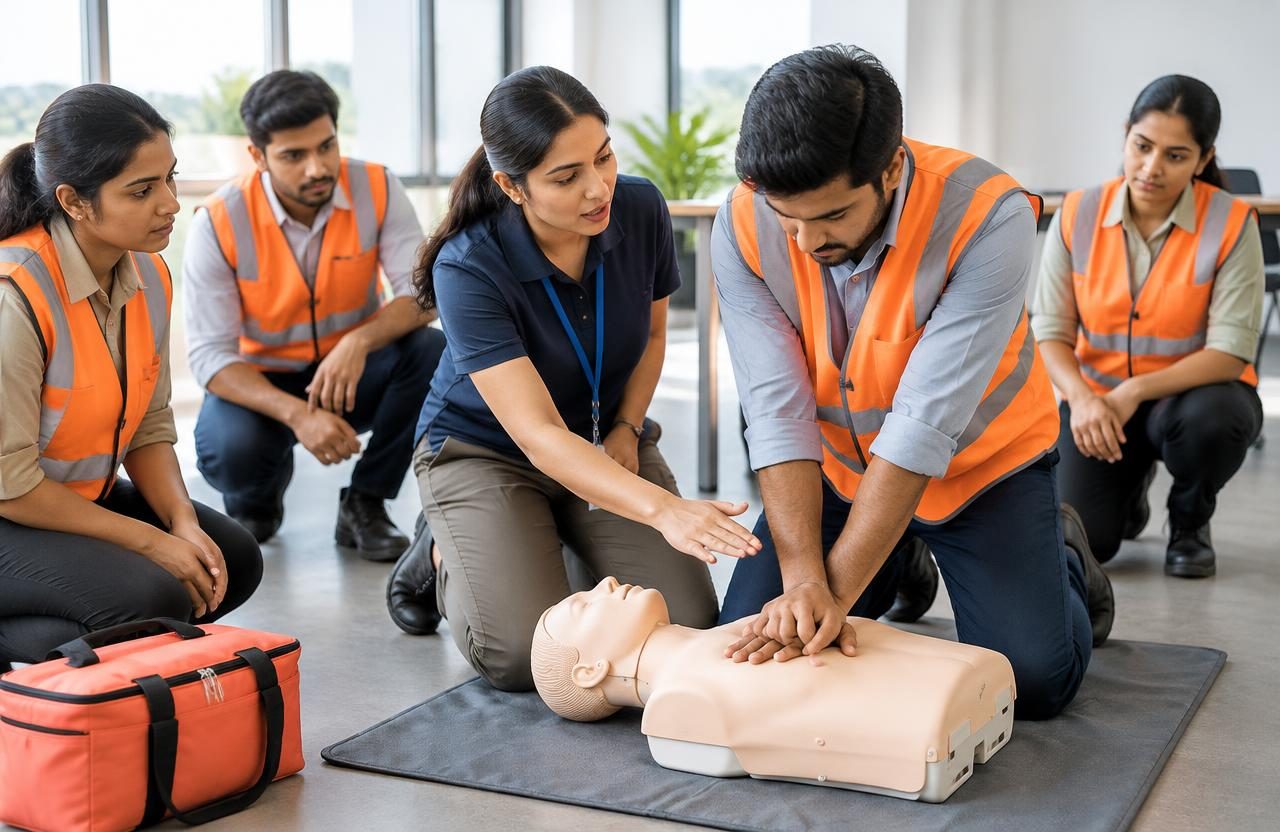
Health Safety India arranges workplace first aid training across India for factories, construction sites, warehouses and offices. Sessions prepare nominated employees, supervisors and security staff to recognise injuries, protect themselves, give initial care and escalate safely, using scenarios drawn from your own hazards. For resuscitation skills, see our combined First Aid & CPR Training in India programme. Trainer availability and local delivery are confirmed per site.
Employer procurement brief
Specify practical first-aid competence for every work area
- What to share
- Injury scenarios, responder distribution, shifts, languages, room and equipment, assessment and certificate conditions.
- What to agree in the proposal
- Agreed injury-care syllabus, practical observation, attendance and follow-up drill priorities; link CPR/AED practice where needed.
Completion does not confer a medical licence or a statutory safety qualification. Emergency services: 108 / 112.
Health Safety India by Jainam Wellness Limited · Local staffing and delivery are confirmed before appointment.
Match your brief to the industry and worksite
Compare actual exposures, workfront access and responder duties before selecting a service scope.
- Residential and commercial high-rise construction health and safety planning
- Metro and rail projects health and safety planning
- Warehouses and 3PL health and safety planning
- Petrochemical crackers health and safety planning
Summary
Health Safety India arranges workplace first aid training across India for factories, construction sites, warehouses and offices. Sessions prepare nominated employees, supervisors and security staff to recognise injuries, protect themselves, give initial care and escalate safely, using scenarios drawn from your own hazards. For resuscitation skills, see our combined First Aid & CPR Training in India programme. Trainer availability and local delivery are confirmed per site.
Who needs it
- Factories developing a shift-wise first-aider network that includes production, maintenance, security and other teams likely to encounter an emergency.
- Corporate offices planning CPR and AED training corporate teams can apply within their actual building access and emergency communication arrangements.
- Warehouses and logistics facilities where large floor areas, vehicle movements and dispersed workstations complicate casualty access and responder coordination.
- Construction projects needing first-response awareness linked to site hazards, changing work fronts and realistic ambulance access routes.
- Employers appointing fire wardens who need clarity on evacuation, accountability and the limits of their role during a developing incident.
- Organisations building internal training capacity while recognising that train-the-trainer participation does not automatically authorise independent certification of others.
What's included
- Scene safety, first aider roles and escalation
- Bleeding, burns, fractures and eye-injury scenarios
- First aid kit review and incident communication
- Practical assessment and certificate requirements agreed before booking
Looking for CPR and AED training as well?
Workplace first aid training focuses on injuries and initial care. If your responders also need resuscitation skills, our combined programme adds CPR practice on manikins, AED familiarisation and a basic life support sequence.
Formats and durations
The final length is agreed with the trainer based on participants' background, batch size and the practical assessment you need.
Full workplace first aid course
Commonly a full working day of hands-on practice and assessment for nominated first aiders.
Refresher session
A shorter session to rehearse key skills and update first aiders on site changes.
Short first aid briefings
Toolbox-style briefings for larger workforces on how to call for help, where first-aid boxes are and what to do until a first aider arrives.
First aid training for factories, construction sites and offices
Factories
Scenarios such as machine injuries, burns, chemical splashes to the eye and electric shock, mapped to your departments and shifts.
Construction sites
Falls, fractures, heavy bleeding, heat illness and remote work fronts, with first aid training for factories and construction sites run in the crews' language.
Warehouses and logistics
Manual handling injuries, forklift and vehicle incidents and night-shift cover.
Offices and corporates
Corporate first aid training on fainting, choking, cuts, burns and how to work with building security and nearby hospitals.
How delivery works across India
Enquiries are accepted PAN India. Training is usually held onsite at your premises; trainer availability, travel and dates are confirmed per site before booking. Multi-site employers can plan a common syllabus with site-specific scenarios.
Certificates and deliverables
- Agreed syllabus and batch schedule
- Attendance records for each batch
- Health Safety India certificate of completion for participants who complete the assessment
- Short feedback note on first-aid boxes and escalation gaps observed
Factory and construction site first aid programmes
This page covers initial injury first aid. Resuscitation (CPR, AED and BLS with manikin practice) is on our first aid and CPR training page; most sites combine both.
Scene safety
Stop the hazard; never enter an unsafe area.
Call 108 / 112
And alert the OHC, supervisor and emergency team.
First aid
Give care within training scope; send for the kit and AED.
Hand over & report
Brief the medic, then record the incident.
Factory first aid programme
- Bleeding and amputation injuries from machines
- Burns: thermal, chemical and electrical
- Eye injuries and eyewash use
- Electrocution: isolate first, then help
- Fractures and crush injuries
- Incident reporting to the OHC
Construction site first aid programme
- Falls from height and spinal precautions
- Heat illness and dehydration
- Cuts, punctures and fractures at work fronts
- Electrical contact on temporary supplies
- Remote-front first aid kits and stretcher access
- Ambulance meeting point and gate guidance
Planning the course
- Named first aiders for every shift and area
- Equipment check: kits, eyewash, stretcher, AED
- Emergency team roles and contacts
- Practical exercises with assessment within course scope
- Onsite room and release from production
Boundaries
- First aid is initial care, not diagnosis or treatment
- Certificate of completion from Health Safety India, not a government accreditation
- Ambulances offered by HSI in Mumbai and Pune only
Official references (check current rules for your state and activity): DGFASLI training programmes (industry context)
Request training proposalDoctors, nurses, trainers and OHC types we provide
MBBS doctors
Registered medical practitioners for OHC consultations, pre-employment and periodic medicals, and emergency stabilisation. Registration is checked with the State Medical Council or NMC.
AFIH, CIH and DIH industrial-health doctors
MBBS doctors with the Associate Fellow of Industrial Health (AFIH), Certificate in Industrial Health (CIH) or Diploma in Industrial Health (DIH). Whether a factory needs one of these depends on the hazards and your state's rules, so we check your site before proposing a doctor.
ANM, GNM and BSc nurses
Auxiliary Nurse Midwife (ANM), General Nursing and Midwifery (GNM) and BSc Nursing staff for shift-wise OHC cover. These qualifications are not interchangeable; registration and permitted scope are checked with the State Nursing Council.
First aid and CPR trainers
Trainers for workplace first aid, CPR/AED, BLS and emergency response teams, delivered on site in shift-friendly batches. Certificate conditions are confirmed in the proposal.
Manufacturing OHC
Occupational health centres for factories and plants: treatment room, medicines, records, medical surveillance for noise, dust, chemicals and heat, and hospital referral links.
Infrastructure OHC
Site clinics for roads, metro, bridges, power and building projects: work-front first aid, labour medicals, height-work fitness, heat-stress checks and ambulance planning (ambulances in Mumbai and Pune only).
Enquiries are accepted across India; local availability is confirmed for each site. Request OHC staffing proposal · First aid and CPR training
Choose realistic batch sizes and hands-on time
For planning, a practical first-aid or CPR/AED batch is often around 12–20 participants per instructor, with smaller groups useful for intensive skills coaching. An awareness talk may accommodate more people. These are indicative delivery sizes, not statutory limits; the final batch depends on equipment, course requirements, participant needs and assessment time.
An onsite session should provide enough manikins, AED trainers and practice opportunities for the agreed outcomes. A large lecture cannot be described as equivalent to individual skills assessment. Split shifts or repeat batches may be needed so workers can attend without leaving operational areas without appropriate cover.
Be precise about certification and instructor status
Certification depends on the selected course, issuer, instructor credentials and assessment arrangements. A participation certificate is not the same as an externally recognised qualification. If a particular authority, customer or internal policy requires recognised training, confirm acceptance and any validity conditions before booking rather than relying on a generic assurance.
Train-the-trainer development can build confidence in demonstrations, facilitation and internal refresher delivery. It does not automatically permit the participant to issue accredited first-aid or BLS certificates. Any instructor authorisation requires its own confirmed pathway. Fire warden attendance likewise does not qualify a person for specialist firefighting or hazardous rescue.
Connect training with site emergency readiness
Training should use the site's alarm methods, emergency numbers, assembly points and ambulance access arrangements. First aiders need to know how to hand over to healthcare personnel and when not to move a casualty. AED planning also includes accessibility, device checks and clear responsibility for maintaining the equipment.
The Occupational Safety, Health and Working Conditions Code, 2020 has been in force since 21 November 2025 with the other three labour codes. State Factories Rules and State BOCW Rules remain legacy references until relevant state OSH rules are notified. One first-aid box per 150 workers is a typical state-rule norm; exact numbers vary by state rules. Training alone does not establish compliance.
How it works
- 01Select the courseConfirm whether participants need awareness, assessed first aid, CPR/BLS, AED, fire warden or instructor-development content. Avoid combining distinct learning outcomes into an unclear certificate.
- 02Plan onsite deliveryAgree language, room, floor space, power, training equipment and shift release. Check that noise, interruptions and production demands will not prevent practical participation.
- 03Teach and demonstrateExplain recognition and response principles in plain language. Demonstrate skills with training equipment and connect them to the site's emergency contacts and access arrangements.
- 04Practise and assessGive participants supervised practice and feedback. Use scenarios and skills checks suited to the course rather than treating attendance alone as evidence of competence.
- 05Record and reinforceIssue the agreed records and eligible certificates. Recommend refresher practice, responder communication and site drills to support skill retention after the session.
Deliverables & records
- A course outline specifying audience, learning outcomes, modules, practical activities and topics excluded from the selected training package.
- An onsite delivery plan identifying room requirements, equipment responsibilities, participant grouping, language and arrangements for different shifts.
- An attendance record and assessment summary distinguishing participation from completion of the course's stated practical requirements.
- Certificates or participation records as agreed, clearly identifying the course, issuer, assessment basis and any applicable recognition or renewal conditions.
- A practical feedback summary highlighting skills needing reinforcement and observations relevant to the site's emergency response arrangements.
- A refresher and internal practice recommendation, with a separate scope statement where train-the-trainer development has been included.
First aid and CPR: buyer questions
How much does workplace first aid training cost in India?
There is no fixed national price. Cost depends on the number of participants and batches, course length, site location and travel, practical equipment, language needs and any certificate or assessment conditions. Share these details for a written quote.
Who should attend corporate first aid training?
Nominate people spread across every shift and area: supervisors, security staff, safety stewards, canteen and admin teams, and contractor supervisors on construction sites. Numbers should follow your risk assessment and the rules that apply to your establishment.
Is first aid training required for factories in India?
First-aid arrangements and trained first aiders are part of factory and construction safety rules, but the exact requirement depends on your state rules, establishment type and workforce during the OSH Code transition. We check applicability for your site rather than assume one national rule.
Can first aid training be held onsite at our factory or construction site?
Yes. Onsite first aid training is the usual format, so scenarios can use your actual layout, hazards, first-aid boxes and emergency contacts. We need a suitable room or covered space and a shift plan that releases participants.
What certificate do participants receive?
Participants who complete the agreed assessment receive a Health Safety India certificate of completion. It is not a government certificate; if a client, authority or contract needs a specific issuing body, tell us before booking so it can be checked.
How is workplace first aid different from CPR training?
Workplace first aid covers a wide range of injuries and initial care. CPR, AED and BLS training focuses on resuscitation. Many employers combine both through our First Aid & CPR Training in India programme.
How often should first aiders take a refresher?
Check your applicable rules, certificate conditions and risk assessment. Many employers schedule periodic refreshers and short skills drills between them; we do not assume one interval for every workplace.
How do we book first aid training in India?
Send your site locations, number of participants, shifts, languages and main hazards through the quote form or call us. We confirm the syllabus, trainer, dates and certificate conditions in a written proposal.
Who should receive workplace first-aid training?
Plan coverage across shifts, work areas and foreseeable absences, based on site risks. Check applicable state rules for any designated first-aider requirements rather than relying only on total attendance.
What should practical training include?
Commonly considered topics include scene safety, raising the alarm, CPR practice, AED familiarisation and initial care for likely injuries. A competent instructor should adapt practice to recognised current guidance and site hazards.
Health Safety India by Jainam Wellness Limited — scope, role eligibility and local availability are confirmed for your site.
Industries served across India
Related services
- Fire Safety and Workplace Emergency Preparedness
- Occupational Health Centre (OHC) in India: Setup & Management for Factories
- Onsite ALS & BLS Ambulance Services for Factories and Construction Sites
- Industrial Nurses for Onsite Health Centres in India
- Construction Site Clinic, Worker Medical Checkups & First Aid
Available across India
Enquiries are accepted PAN India. This directory does not confirm a branch, clinic, staff or fleet in any city; local deployment is confirmed per site.
- Andhra Pradesh
- Arunachal Pradesh
- Assam
- Bihar
- Chhattisgarh
- Goa
- Gujarat
- Haryana
- Himachal Pradesh
- Jharkhand
- Karnataka
- Kerala
- Madhya Pradesh
- Maharashtra
- Manipur
- Meghalaya
- Mizoram
- Nagaland
- Odisha
- Punjab
- Rajasthan
- Sikkim
- Tamil Nadu
- Telangana
- Tripura
- Uttar Pradesh
- Uttarakhand
- West Bengal
- Andaman and Nicobar Islands
- Chandigarh
- Dadra and Nagar Haveli and Daman and Diu
- Delhi
- Jammu and Kashmir
- Ladakh
- Lakshadweep
- Puducherry
- Workplace First Aid Training in Mumbai
- Workplace First Aid Training in Navi Mumbai
- Workplace First Aid Training in Pune
- Workplace First Aid Training in Thane
- Workplace First Aid Training in Delhi NCR
- Workplace First Aid Training in Gurugram
- Workplace First Aid Training in Noida
- Workplace First Aid Training in Ahmedabad
- Workplace First Aid Training in Vadodara
- Workplace First Aid Training in Surat
- Workplace First Aid Training in Bengaluru
- Workplace First Aid Training in Chennai
- Workplace First Aid Training in Coimbatore
- Workplace First Aid Training in Hyderabad
- Workplace First Aid Training in Kolkata
- Workplace First Aid Training in Jamshedpur
- Workplace First Aid Training in Raipur
- Workplace First Aid Training in Nagpur
- Workplace First Aid Training in Indore
- Workplace First Aid Training in Jaipur
- Workplace First Aid Training in Lucknow
- Workplace First Aid Training in Kochi
- Workplace First Aid Training in Visakhapatnam
- Workplace First Aid Training in Bhubaneswar
- Workplace First Aid Training in Chandigarh
- Workplace First Aid Training in Guwahati
- Workplace First Aid Training in Panaji
- Workplace First Aid Training in Gandhinagar
- Workplace First Aid Training in Rajkot
- Workplace First Aid Training in Bharuch
- Workplace First Aid Training in Ankleshwar
- Workplace First Aid Training in Vapi
- Workplace First Aid Training in Jamnagar
- Workplace First Aid Training in Bhavnagar
- Workplace First Aid Training in Mundra
- Workplace First Aid Training in Aurangabad
- Workplace First Aid Training in Nashik
- Workplace First Aid Training in Kolhapur
- Workplace First Aid Training in Boisar
- Workplace First Aid Training in Bhopal
- Workplace First Aid Training in Gwalior
- Workplace First Aid Training in Patna
- Workplace First Aid Training in Ranchi
- Workplace First Aid Training in Dhanbad
- Workplace First Aid Training in Bokaro
- Workplace First Aid Training in Bhilai
- Workplace First Aid Training in Korba
- Workplace First Aid Training in Dehradun
- Workplace First Aid Training in Haridwar
- Workplace First Aid Training in Rudrapur
- Workplace First Aid Training in Shimla
- Workplace First Aid Training in Baddi
- Workplace First Aid Training in Srinagar
- Workplace First Aid Training in Jammu
- Workplace First Aid Training in Leh
- Workplace First Aid Training in Ludhiana
- Workplace First Aid Training in Amritsar
- Workplace First Aid Training in Jalandhar
- Workplace First Aid Training in Mohali
- Workplace First Aid Training in Faridabad
- Workplace First Aid Training in Manesar
- Workplace First Aid Training in Panipat
- Workplace First Aid Training in Sonipat
- Workplace First Aid Training in Ghaziabad
- Workplace First Aid Training in Greater Noida
- Workplace First Aid Training in Kanpur
- Workplace First Aid Training in Agra
- Workplace First Aid Training in Varanasi
- Workplace First Aid Training in Udaipur
- Workplace First Aid Training in Jodhpur
- Workplace First Aid Training in Bhiwadi
- Workplace First Aid Training in Kota
- Workplace First Aid Training in Thiruvananthapuram
- Workplace First Aid Training in Mangaluru
- Workplace First Aid Training in Mysuru
- Workplace First Aid Training in Hubballi
- Workplace First Aid Training in Bellary
- Workplace First Aid Training in Hosur
- Workplace First Aid Training in Sriperumbudur
- Workplace First Aid Training in Madurai
- Workplace First Aid Training in Tiruchirappalli
- Workplace First Aid Training in Tiruppur
- Workplace First Aid Training in Thoothukudi
- Workplace First Aid Training in Amaravati
- Workplace First Aid Training in Vijayawada
- Workplace First Aid Training in Sri City
- Workplace First Aid Training in Kakinada
- Workplace First Aid Training in Warangal
- Workplace First Aid Training in Rourkela
- Workplace First Aid Training in Angul
- Workplace First Aid Training in Jharsuguda
- Workplace First Aid Training in Paradip
- Workplace First Aid Training in Durgapur
- Workplace First Aid Training in Asansol
- Workplace First Aid Training in Haldia
- Workplace First Aid Training in Siliguri
- Workplace First Aid Training in Dibrugarh
- Workplace First Aid Training in Gangtok
- Workplace First Aid Training in Shillong
- Workplace First Aid Training in Agartala
- Workplace First Aid Training in Imphal
- Workplace First Aid Training in Aizawl
- Workplace First Aid Training in Kohima
- Workplace First Aid Training in Itanagar
- Workplace First Aid Training in Port Blair
- Workplace First Aid Training in Silvassa
- Workplace First Aid Training in Daman
- Workplace First Aid Training in Oragadam
- Workplace First Aid Training in Salem
- Workplace First Aid Training in Tirupati
- Workplace First Aid Training in Nellore
- Workplace First Aid Training in Patancheru
- Workplace First Aid Training in Pithampur
- Workplace First Aid Training in Dewas
- Workplace First Aid Training in Mandideep
- Workplace First Aid Training in Kalinganagar
- Workplace First Aid Training in Dahej
- Workplace First Aid Training in Sanand
- Workplace First Aid Training in Halol
- Workplace First Aid Training in Hazira
- Workplace First Aid Training in Morbi
- Workplace First Aid Training in Mehsana
- Workplace First Aid Training in Gandhidham
- Workplace First Aid Training in Chakan
- Workplace First Aid Training in Pimpri-Chinchwad
- Workplace First Aid Training in Khopoli
- Workplace First Aid Training in Solapur
- Workplace First Aid Training in Bawal
- Workplace First Aid Training in Dharuhera
- Workplace First Aid Training in Rewari
- Workplace First Aid Training in Bahadurgarh
- Workplace First Aid Training in Neemrana
- Workplace First Aid Training in Alwar
- Workplace First Aid Training in Meerut
- Workplace First Aid Training in Mathura
- Workplace First Aid Training in Gorakhpur
- Workplace First Aid Training in Prayagraj
- Workplace First Aid Training in Pantnagar
- Workplace First Aid Training in Kashipur
- Workplace First Aid Training in Roorkee
- Workplace First Aid Training in Nalagarh
- Workplace First Aid Training in Belagavi
- Workplace First Aid Training in Tumakuru
- Workplace First Aid Training in Hosapete
- Workplace First Aid Training in Palakkad
- Workplace First Aid Training in Kozhikode
- Workplace First Aid Training in Verna
- Workplace First Aid Training in Puducherry
- Workplace First Aid Training in Kavaratti
Related workplace health and safety services
Practical guides for your site
Get a quote for workplace first aid training in india
Health Safety India by Jainam Wellness Limited