Service
Hazard-Specific Health Surveillance for Industrial Workers
Hazard-specific health surveillance looks for health effects associated with identified workplace exposures. A hazardous process medical examination should connect process knowledge, exposure assessment and clinical judgement, with a defined response to abnormal findings rather than a standard panel applied to every worker.
Summary
Hazard-specific health surveillance looks for health effects associated with identified workplace exposures. A hazardous process medical examination should connect process knowledge, exposure assessment and clinical judgement, with a defined response to abnormal findings rather than a standard panel applied to every worker.
Who needs it
- Dust-generating operations where respirable crystalline silica may be present and workers need an appropriately designed respiratory surveillance pathway.
- Factories with significant noise exposure that require suitable audiometry for factory workers alongside hearing conservation and exposure-control measures.
- Battery, metal, pigment or chemical operations where substance-specific surveillance or biological monitoring may be justified by the actual exposure.
- Workplaces reporting repeated dermatitis, breathing symptoms or other patterns that need structured clinical review and investigation of possible workplace links.
- Hazardous-process sites seeking to align worker examinations with process inventories, safety data sheets, exposure groups and relevant state requirements.
- Employers reviewing existing screening programmes that generate reports but lack reliable trend analysis, specialist referral or action on workplace controls.
What's included
- Review of processes, substances, safety data sheets, work histories and available industrial hygiene information before selecting surveillance components.
- Identification of similar exposure groups, including maintenance, cleaning and contract roles that may have different exposure patterns from production staff.
- A clinician-led protocol defining relevant history, examination, tests, review intervals and triggers for additional assessment or referral.
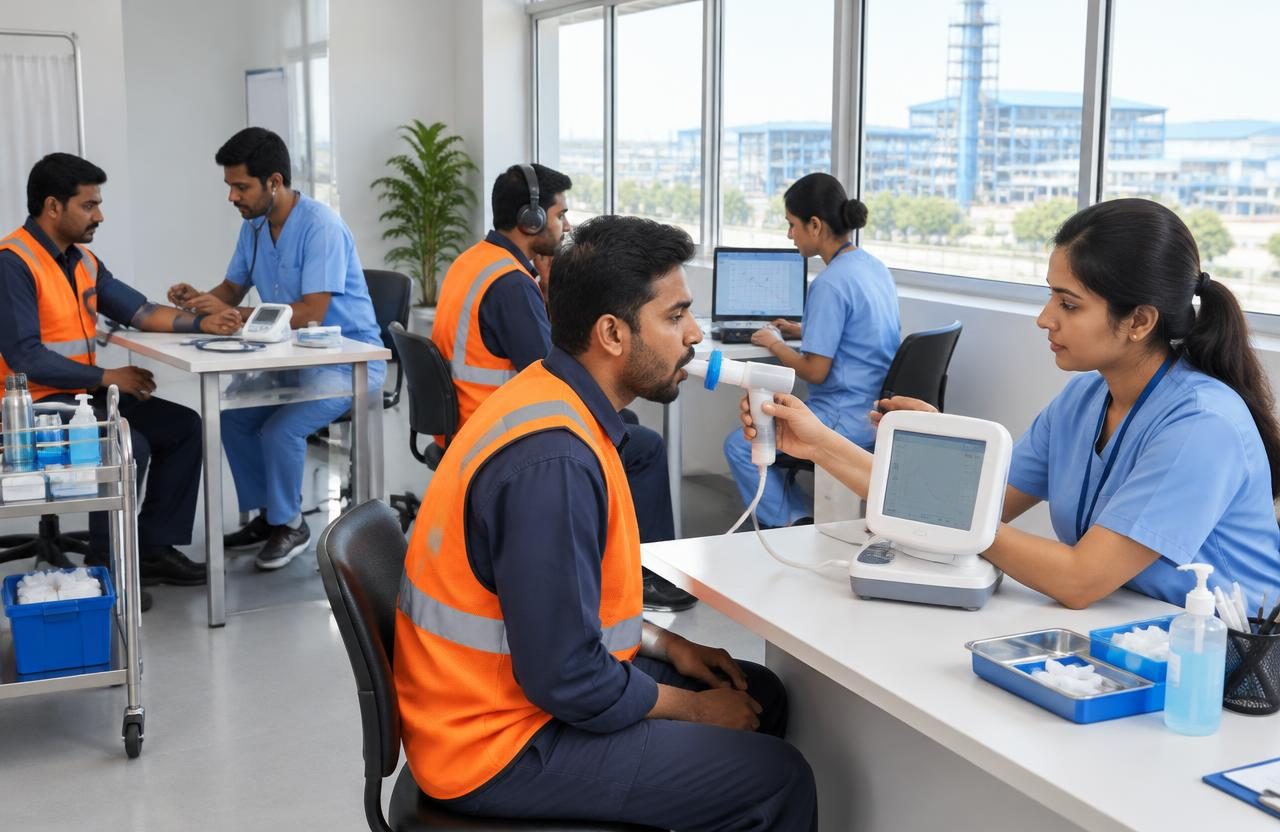
- Coordination of suitable testing conditions, competent personnel and quality checks for assessments such as audiometry or respiratory function testing.
- Clinical interpretation that considers symptoms, exposure history, test limitations and earlier results rather than relying only on automated classifications.
- Individual advice, work-related recommendations and referral coordination for findings that require further evaluation, treatment or specialist assessment.
- An anonymised feedback route to safety and operations teams so emerging patterns prompt review of exposure controls and work practices.
Silicosis screening needs an exposure history
Silicosis screening is relevant where respirable crystalline silica exposure is plausible, such as certain stone, foundry, construction or mineral-processing tasks. A clinician should review the material, task, duration, control measures and symptoms before selecting investigations. Imaging is not a universal requirement for every dusty workplace and should be clinically justified.
Respiratory symptoms can have several causes. Screening findings may prompt specialist evaluation, but they do not alone establish a diagnosis or prove that work caused the condition. Workers need a clear referral pathway, while employers need to review dust generation, control effectiveness and exposure assessment without waiting for confirmed disease.
Audiometry and biological monitoring require quality
Audiometry for factory workers should sit within a hearing conservation programme. Equipment condition, the test environment, worker instructions and relevant recent noise exposure affect interpretation. A change from earlier results may require confirmation and clinical review. Hearing protection provision alone does not resolve the need to reduce hazardous noise.
Biological monitoring must be substance-specific. Sample timing, collection technique, laboratory capability and non-work exposures may all matter. There is no meaningful universal heavy-metal panel for every factory. The responsible clinician should define what is being measured, why it is relevant and what action follows an unexpected result.
Surveillance supports controls; it does not replace them
The Occupational Safety, Health and Working Conditions Code, 2020 has been in force since 21 November 2025 with the other three labour codes. It consolidates 13 central laws, including the Factories Act, 1948. State Factories Rules remain legacy references until relevant state OSH rules are notified; hazardous-process requirements need state-specific confirmation.
A hazardous process medical examination is one part of risk management. Normal findings do not establish safe exposure, and testing must not become permission to continue inadequate controls. Engineering measures, suitable procedures, maintenance, training and exposure assessment remain central. Surveillance should help reveal when prevention needs closer attention.
How it works
- 01Characterise the exposureReview tasks, materials, exposure measurements and work histories. Identify information gaps that prevent a reliable choice of surveillance protocol.
- 02Define the surveillance questionSpecify which health effects are being monitored and how results will change action. Agree groups, methods, intervals, referral triggers and clinical oversight.
- 03Establish a usable baselineCollect relevant history and perform selected assessments under suitable conditions. Record job and exposure context so future findings can be interpreted meaningfully.
- 04Review individual findingsThe clinician evaluates results and arranges clarification or specialist referral when indicated. Communicate appropriate work advice without prematurely assigning occupational causation.
- 05Act on patternsReview anonymised trends with the relevant teams, investigate exposure concerns and improve controls. Revisit the protocol when substances, processes or worker assignments change.
Deliverables & records
- An exposure-to-surveillance matrix linking worker groups, potential health effects, selected assessments and the reasons for including each component.
- A protocol describing methods, preparation requirements, quality considerations, examination intervals and the circumstances requiring earlier clinical review.
- Individual confidential surveillance records with job history, relevant results and sufficient context to support later clinical interpretation.
- Doctor-reviewed recommendations identifying work restrictions, additional assessment, specialist referral or follow-up where clinically justified.
- A follow-up register separating pending tests, unresolved clinical questions and actions that require workplace exposure-control review.
- An anonymised trend report outlining limitations, prevention priorities and areas needing better exposure information rather than unsupported disease-rate claims.
Exposure surveillance, occupational disease and wellness: buyer questions
Does every dusty workplace need silicosis screening?
Not every dust contains crystalline silica, and exposure levels and tasks differ. Start with material and exposure information. Where silica risk is credible, an occupational clinician should define an appropriate respiratory surveillance pathway and referral criteria rather than ordering the same imaging for everyone.
Can audiometry diagnose occupational hearing loss by itself?
No. It measures hearing thresholds and can identify changes requiring evaluation. Clinical history, test quality, earlier results and exposure information are needed to interpret those changes. Specialist assessment may be necessary before determining the nature or likely causes of hearing loss.
Is spirometry suitable for all workers?
Its use depends on the surveillance purpose and clinical suitability. Testing requires appropriate technique, worker cooperation and quality review. Some individuals may need assessment before proceeding. A report should not be treated as definitive simply because a machine generated a classification.
What happens after a concerning surveillance result?
The clinician should explain the finding, arrange appropriate confirmation or referral and consider work-related advice. In parallel, the employer should review relevant exposures and controls using anonymised information where possible. Clinical follow-up and workplace investigation are connected but distinct responsibilities.
Can surveillance show whether our controls are effective?
It may provide useful warning signals, but cannot establish control effectiveness on its own. Some health effects develop slowly or are not detected by available tests. Use surveillance alongside industrial hygiene assessment, process review and verification that engineering and administrative controls are functioning.
Can audiometry replace control of factory noise?
No. Audiometry supports surveillance when clinically and legally appropriate. Assess exposure and prioritise engineering and work controls with suitable hearing protection; normal results do not prove noise is safe.
What is the purpose of occupational spirometry?
It can help evaluate respiratory function within a clinically selected surveillance programme. Qualified interpretation, technique and exposure context matter; it is not a stand-alone diagnosis or permission for dusty work.
How should chemical exposure information reach the doctor?
Share process details, safety data sheets, exposure assessments and incident information through a suitable channel. The doctor selects appropriate follow-up; avoid generic biomarker testing without a valid clinical and exposure basis.
How can ergonomic health concerns be prevented?
Review task design, load, repetition, posture, tools and recovery with worker input. Clinical referral may be needed for symptoms, but stretching sessions alone do not correct poorly designed work.
What should suspected occupational disease trigger?
Arrange confidential clinical assessment and review the relevant exposure and control evidence. Check applicable reporting and specialist referral duties; do not label a worker or dismiss a work connection without assessment.
Health Safety India by Jainam Wellness Limited — scope, role eligibility and local availability are confirmed for your site.
Related industries
Related services
Training and safety staffing support
Combine this with trained first aid and CPR responders, task-based safety training and, where the role requires it, a qualified safety officer on contract.
Hazard-Specific Health Surveillance for Industrial Workers by state
Get a quote for hazard-specific health surveillance for industrial workers
Health Safety India by Jainam Wellness Limited