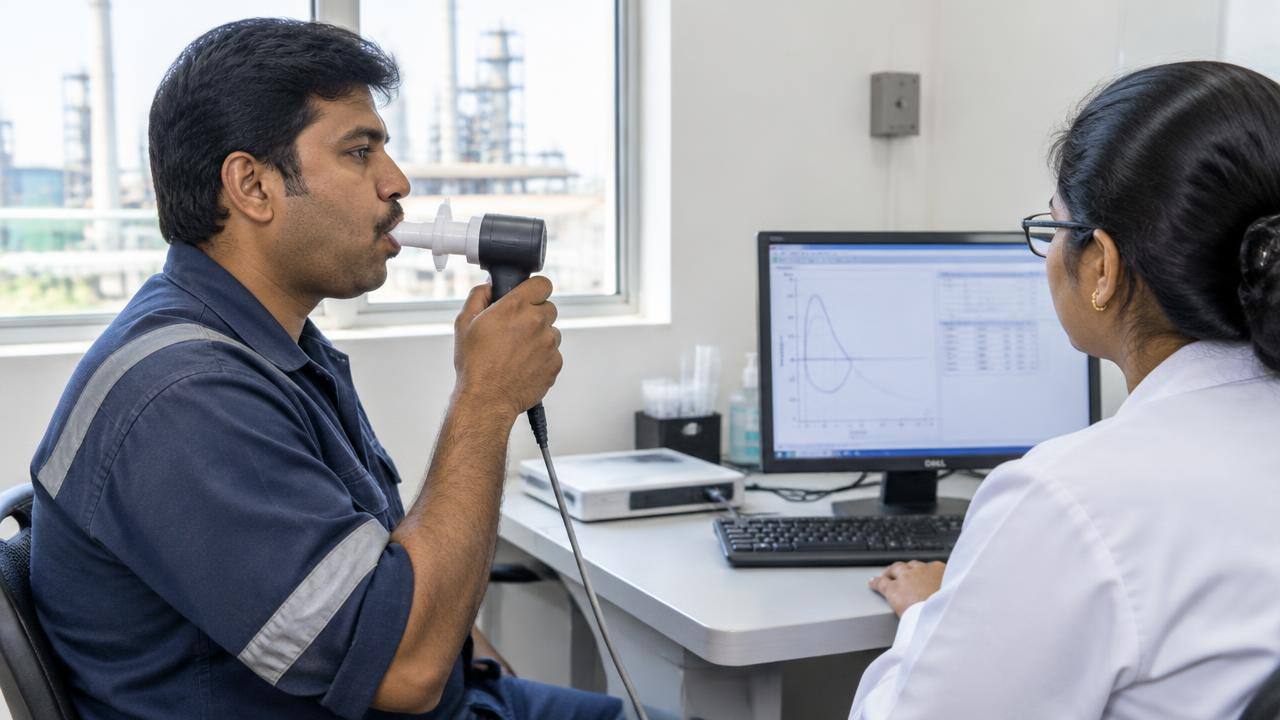
Dust, fumes and sensitisers can damage the lungs over years. Spirometry measures how much air a person can blow out and how fast, and is widely used in occupational respiratory surveillance. It is useful only when tests are done well and compared over time. A normal test does not prove dust is controlled; it is one part of a programme with dust measurement and control. The examining doctor (a registered medical practitioner) decides the final protocol, intervals and fitness opinion.
Where spirometry is commonly considered
| Exposure | Typical settings | Concern |
|---|---|---|
| Respirable crystalline silica | Stone cutting, foundries, ceramics, tunnelling | Silicosis and other lung disease |
| Cement and mineral dust | Cement plants, construction | Airway irritation |
| Cotton and organic dust | Textiles, food processing | Byssinosis, asthma |
| Welding fumes | Fabrication, shipyards | Airway irritation |
| Sensitisers | Pharma powders, isocyanate paints, flour, enzymes | Occupational asthma |
Getting reliable results
- 1Use a calibrated spirometer and check calibration as the maker advises.
- 2Record age, height and other details accurately.
- 3Ask about recent illness, smoking and contraindications first.
- 4Coach the worker and repeat blows until results are consistent.
- 5Have results interpreted by a trained clinician and compared with earlier tests.
- 6Explain results and refer when the doctor advises.
For factories
Use dust monitoring results to decide exposure groups. Compare each worker's results over the years, not just against a single reference value.
For construction sites
Cutting, drilling and grinding concrete or stone generate silica dust. Combine wet cutting and on-tool extraction with baseline spirometry for long-term crews, and keep records that follow workers between contractors.
Limits of spirometry
- It does not identify the cause on its own
- Poor effort or coaching gives misleading results
- Early disease can be missed
- It cannot replace dust control and respirators
Legal context in India
The Occupational Safety, Health and Working Conditions Code, 2020 (OSH Code) came into force on 21 November 2025 and consolidates 13 central laws, including the Factories Act, 1948 and the Building and Other Construction Workers (BOCW) Act, 1996. Many states are still notifying their OSH Code rules, so existing State Factory Rules and BOCW State Rules remain the practical reference for many formats and norms during the transition.
Staffing levels, examination intervals, register formats and qualifications vary by state, process and workforce. Check the applicable state rules before treating any figure as a requirement. This is general information, not legal or medical advice; a registered medical practitioner decides any clinical protocol.
Plan this with Health Safety India
Health Safety India by Jainam Wellness Ltd. helps factories and construction projects plan spirometry and respiratory surveillance. Share your headcount, shifts, processes and location through the quote form, or call +91 8591983184 / 9820891087. Enquiries are accepted PAN India and local deployment is confirmed per site. Ambulance services are available in Mumbai and Pune only; in an emergency call 108 or 112.
Frequently asked questions
- Is spirometry the same as a PFT?
- Spirometry is the most common pulmonary function test (PFT); full PFTs include other measures.
- Do all dust-exposed workers need chest X-rays?
- Not routinely; the doctor decides imaging from exposure and clinical findings.
- How often is spirometry repeated?
- At the interval the doctor or applicable rules set for the exposure.
- Can smoking affect results?
- Yes. Smoking history is recorded and cessation support helps protect lung health.
- Can spirometry be done in an onsite camp?
- Yes, with calibrated equipment, a trained technician and a quiet, private space.
Talk to our occupational health and safety team
Health Safety India by Jainam Wellness Limited — onsite OHCs, safety audits, safety training, fire safety and environmental audits for PAN India enquiries; ambulances are Mumbai and Pune only. Call +91 8591983184 / 9820891087 or write to info@planmyhealth.in.
Explore the related occupational health serviceSources
- Ministry of Labour & Employment — labour codes
- ICMR-National Institute of Occupational Health
- NIOSH (CDC) — workplace safety and health
- WHO — occupational health
General information, not legal or medical advice. A registered medical practitioner decides any examination protocol, and applicable rules vary by state and during the OSH Code transition.
Related workplace health and safety services
Related reading
Audiometry and Noise-Induced Hearing Loss Screening in Factories
Read Environment & HealthDust, Drinking Water, Sanitation and Labour-Camp Hygiene on Construction Sites
Read Occupational HealthNotifiable occupational diseases in India and how to catch them early
Read Occupational HealthOHC Vendor RFP & SLA Checklist for Factories and Construction Projects in India
Read