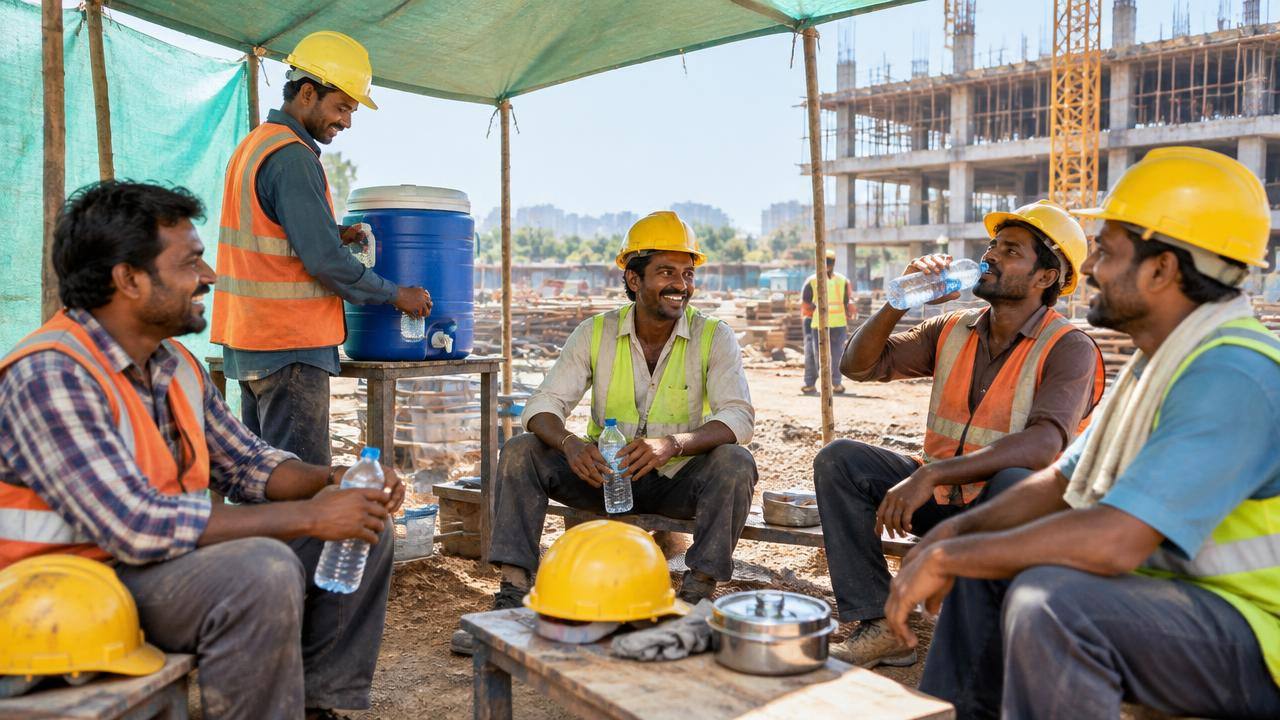
Indian construction workers face two hard seasons: extreme summer heat and intense monsoon rain. Heat illness can progress quickly from cramps to life-threatening heat stroke. Monsoon brings electrical hazards, excavation collapses, slips and water- and vector-borne disease. Planning both seasons in advance protects workers and keeps projects moving. Heat stroke is an emergency: call 108 or 112 and start cooling immediately.
Heat illness: signs and response
| Condition | Signs | First response |
|---|---|---|
| Heat cramps | Painful muscle cramps | Rest in shade, fluids, stretch |
| Heat exhaustion | Heavy sweating, weakness, dizziness, nausea | Shade, cool, fluids, monitor; get medical advice |
| Heat stroke | Confusion, collapse, hot skin, seizures | Emergency: call 108/112, cool aggressively, stay with the person |
Summer heat plan
- 1Track local heat warnings from IMD and state heat action plans.
- 2Provide cool drinking water near every work front.
- 3Set up shaded rest areas and scheduled breaks.
- 4Move heavy work to early morning or evening.
- 5Acclimatise new and returning workers gradually.
- 6Use a buddy system and train first-aiders on heat illness.
- 7Ask the OHC doctor about workers with conditions that increase heat risk.
Monsoon readiness checklist
- Inspect temporary electrics; use RCDs/ELCBs and weatherproof boards
- Check excavation support and drainage after heavy rain
- Secure scaffolds, formwork and loose materials against wind
- Stop crane and height work in lightning or high wind
- Provide non-slip walkways and lighting
- Control standing water to prevent mosquito breeding
- Check drinking water quality and camp sanitation
For construction sites
Exposed roofs and slabs get much hotter than the shade temperature. Include heat and monsoon topics in toolbox talks and the site emergency plan.
For factories
Furnaces, foundries, kitchens and poorly ventilated sheds can create heat stress indoors all year. Measure heat at work areas and improve ventilation and cooling first.
Legal context in India
The Occupational Safety, Health and Working Conditions Code, 2020 (OSH Code) came into force on 21 November 2025 and consolidates 13 central laws, including the Factories Act, 1948 and the Building and Other Construction Workers (BOCW) Act, 1996. Many states are still notifying their OSH Code rules, so existing State Factory Rules and BOCW State Rules remain the practical reference for many formats and norms during the transition.
Staffing levels, examination intervals, register formats and qualifications vary by state, process and workforce. Check the applicable state rules before treating any figure as a requirement. This is general information, not legal or medical advice; a registered medical practitioner decides any clinical protocol.
Plan this with Health Safety India
Health Safety India by Jainam Wellness Ltd. helps factories and construction projects plan heat and monsoon safety. Share your headcount, shifts, processes and location through the quote form, or call +91 8591983184 / 9820891087. Enquiries are accepted PAN India and local deployment is confirmed per site. Ambulance services are available in Mumbai and Pune only; in an emergency call 108 or 112.
Frequently asked questions
- What should we do if a worker collapses in heat?
- Treat as heat stroke until proven otherwise: call 108/112, move to shade, cool rapidly and monitor.
- How much water should workers drink?
- Encourage small amounts often; the OHC doctor can advise for your conditions.
- Should work stop during heat waves?
- Follow your state heat action plan and site rules; reschedule heavy work to cooler hours.
- Which monsoon diseases affect sites?
- Commonly mosquito-borne and water-borne infections; prevention relies on water, sanitation and vector control.
- Is medical screening useful for heat?
- The doctor may identify workers needing extra care; fitness checks support, not replace, heat controls.
Talk to our occupational health and safety team
Health Safety India by Jainam Wellness Limited — onsite OHCs, safety audits, safety training, fire safety and environmental audits for PAN India enquiries; ambulances are Mumbai and Pune only. Call +91 8591983184 / 9820891087 or write to info@planmyhealth.in.
Explore the related occupational health serviceSources
- Ministry of Labour & Employment — labour codes
- National Disaster Management Authority — heat wave guidance
- India Meteorological Department
- WHO — occupational health
General information, not legal or medical advice. A registered medical practitioner decides any examination protocol, and applicable rules vary by state and during the OSH Code transition.
Related workplace health and safety services
Related reading
A 52-Week Toolbox Talk Calendar for Factories and Construction Sites
Read Environment & HealthDust, Drinking Water, Sanitation and Labour-Camp Hygiene on Construction Sites
Read Labour FitnessContract and Migrant Worker Health: Screening, Vaccination and Welfare on Large Sites
Read Occupational HealthOHC Vendor RFP & SLA Checklist for Factories and Construction Projects in India
Read