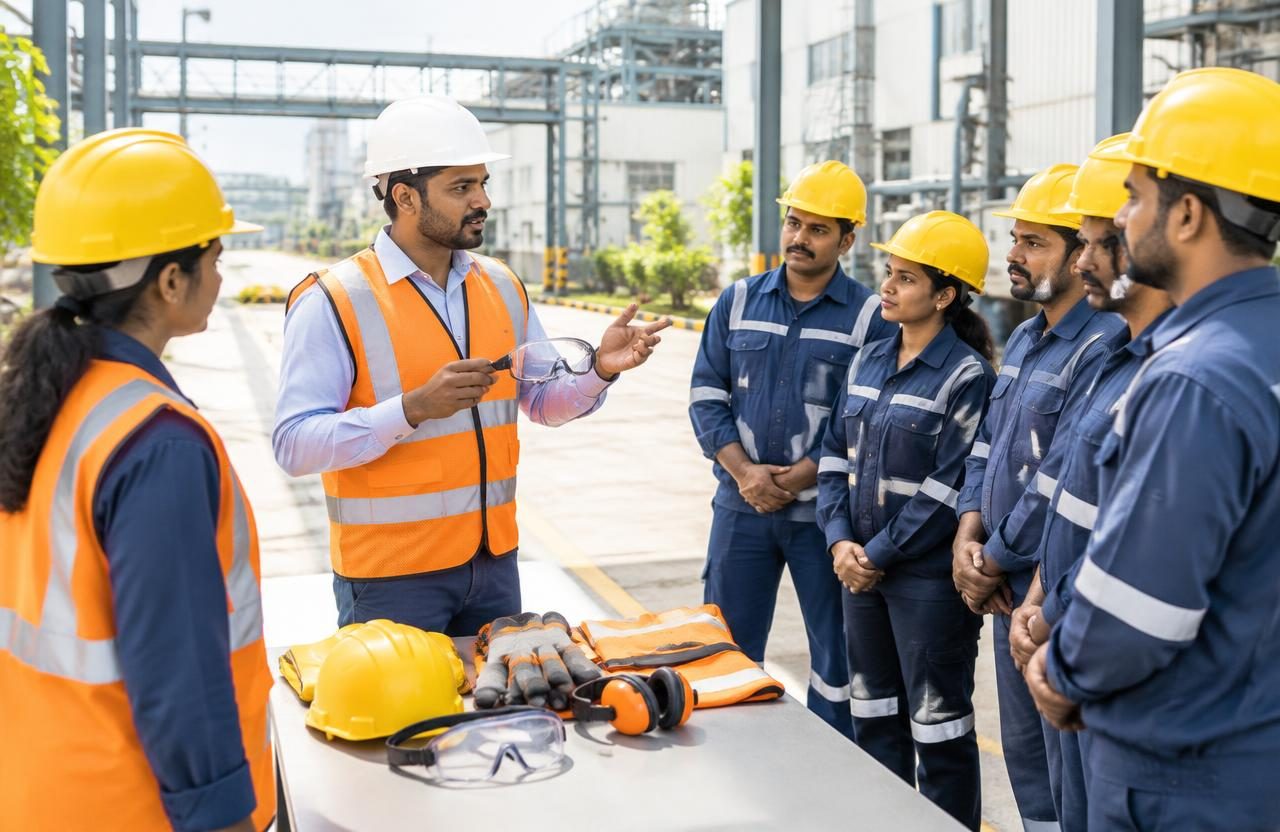
A toolbox talk is a short, focused safety briefing given at the workplace before work starts. Weekly talks keep safety visible, but repeated generic talks quickly become background noise. The calendar below follows the Indian year — summer heat, monsoon and festive months — and should be adapted to your site's own hazards and recent incidents.
The calendar
Week 1 starts in January; adjust for your financial year if preferred.
| Weeks | Theme | Topics |
|---|---|---|
| 1-4 | Safety basics | Site rules and reporting; PPE check; housekeeping; slips and trips |
| 5-8 | Lifting and equipment | Manual handling; hand tools; power tools; ladders |
| 9-12 | Fire and emergency | Fire triangle and extinguishers; evacuation routes; emergency numbers 108/112; first aid basics |
| 13-17 | Summer heat | Heat stress signs; hydration; rest-shade-water; sun protection; buddy checks |
| 18-21 | High-risk work | Work at height; scaffolds; hot work; confined spaces |
| 22-26 | Monsoon readiness | Electrical safety in rain; slippery surfaces; excavation collapse; lightning; vector-borne disease |
| 27-30 | Machinery | Machine guarding; lockout-tagout; forklifts and pedestrians; cranes and lifting |
| 31-34 | Health | Noise and hearing; dust and lungs; chemicals and SDS; skin care |
| 35-38 | People | Fatigue and night shifts; alcohol and medicines; stress; ergonomics |
| 39-42 | Festive season | Fireworks and fire risk; travel safety; new-joiner induction; contractor safety |
| 43-46 | Vehicles and traffic | Site traffic plans; reversing vehicles; driver fitness; road safety |
| 47-50 | Environment | Waste segregation; spill response; water and sanitation; dust control |
| 51-52 | Year review | Lessons from incidents; worker suggestions for next year |
How to deliver a talk well
- 1Pick one topic and one key message.
- 2Use a real example from your site or a near miss.
- 3Show the equipment or location if possible.
- 4Ask two or three questions.
- 5Record attendance and any concerns raised.
- 6Close actions before the next talk.
For factories
Give department-specific talks; a press shop and a warehouse face different hazards. Rotate talks across shifts so night-shift workers are not missed.
For construction sites
Hold talks at the work front at the start of each shift and in the workers' language. Shift heat and monsoon topics earlier if your region's season starts earlier.
Legal context in India
The Occupational Safety, Health and Working Conditions Code, 2020 (OSH Code) came into force on 21 November 2025 and consolidates 13 central laws, including the Factories Act, 1948 and the Building and Other Construction Workers (BOCW) Act, 1996. Many states are still notifying their OSH Code rules, so existing State Factory Rules and BOCW State Rules remain the practical reference for many formats and norms during the transition.
Staffing levels, examination intervals, register formats and qualifications vary by state, process and workforce. Check the applicable state rules before treating any figure as a requirement. This is general information, not legal or medical advice; a registered medical practitioner decides any clinical protocol.
Plan this with Health Safety India
Health Safety India by Jainam Wellness Ltd. helps factories and construction projects plan toolbox talks and safety sessions. Share your headcount, shifts, processes and location through the quote form, or call +91 8591983184 / 9820891087. Enquiries are accepted PAN India and local deployment is confirmed per site. Ambulance services are available in Mumbai and Pune only; in an emergency call 108 or 112.
Frequently asked questions
- How long should a toolbox talk be?
- Usually 5-15 minutes; short enough to keep attention, focused on one topic.
- Who should give toolbox talks?
- Supervisors or safety officers, ideally the person who leads the crew.
- Do toolbox talks replace formal training?
- No. They reinforce training; formal competence training is separate.
- Should attendance be recorded?
- Yes, with date, topic and attendee names or signatures.
- What language should talks be in?
- The language workers understand best; use interpreters for mixed crews.
Talk to our occupational health and safety team
Health Safety India by Jainam Wellness Limited — onsite OHCs, safety audits, safety training, fire safety and environmental audits for PAN India enquiries; ambulances are Mumbai and Pune only. Call +91 8591983184 / 9820891087 or write to info@planmyhealth.in.
Explore the related occupational health serviceSources
- Ministry of Labour & Employment — labour codes
- International Labour Organization — OSH
- National Disaster Management Authority — heat wave guidance
- DGFASLI — occupational safety and health
General information, not legal or medical advice. A registered medical practitioner decides any examination protocol, and applicable rules vary by state and during the OSH Code transition.
Related workplace health and safety services
Related reading
Heat Stress and Monsoon Safety on Construction Sites
Read Health, Safety & EnvironmentSafety and Health Sessions at Construction Sites and Factories in India
Read Safety AuditSafety training that changes behaviour: programmes every Indian workplace needs
Read Occupational HealthOHC Vendor RFP & SLA Checklist for Factories and Construction Projects in India
Read