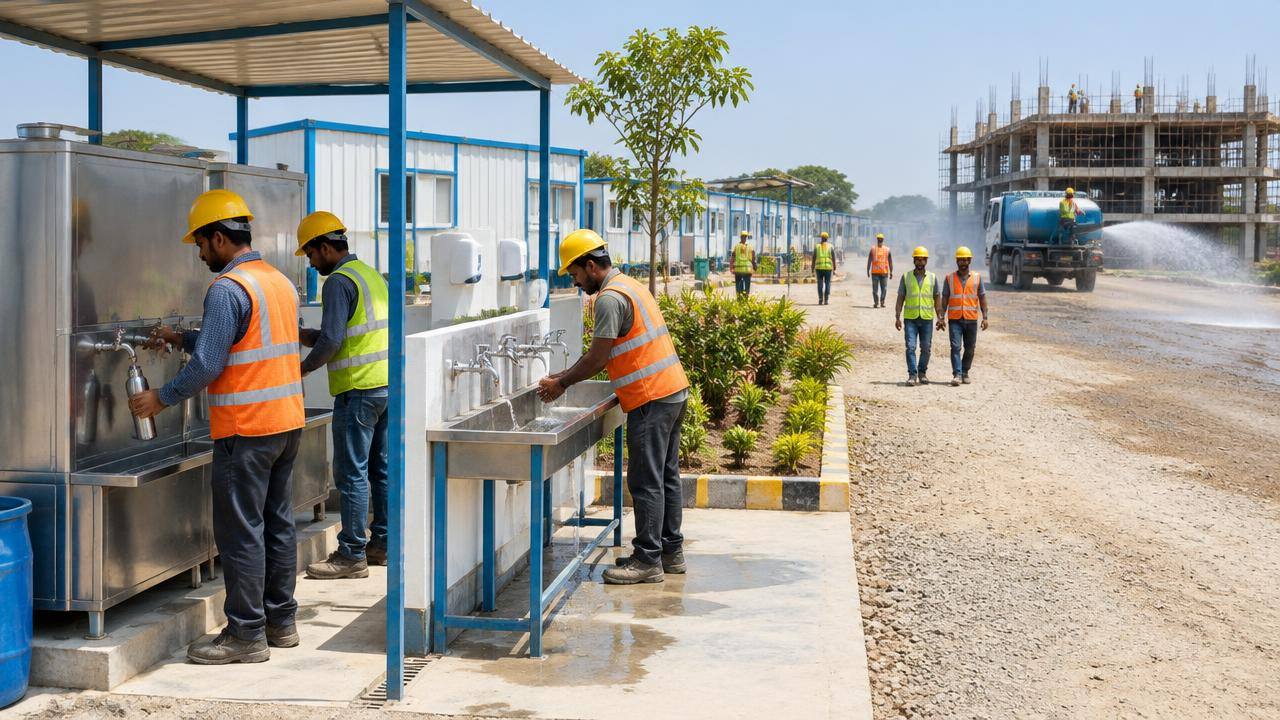
Construction dust affects workers and neighbours, and poor water and sanitation in labour camps can cause outbreaks that stop work. Many cities and pollution control boards issue dust-control directions for construction, and BOCW-related rules set welfare expectations — check the current local requirements. The practical controls below support both compliance and worker health.
Dust controls
- Wet cutting and on-tool extraction for concrete and stone
- Cover stockpiles and trucks; wheel washing at exits
- Barricades or screens on site boundaries
- Water sprinkling on haul roads
- Respiratory protection where dust remains
Camp and site welfare checklist
| Area | What good looks like |
|---|---|
| Drinking water | Safe source, tested periodically, covered clean containers, cups or taps |
| Toilets | Adequate number, separate for women, cleaned daily, water and lighting |
| Handwashing | Soap and water near toilets and eating areas |
| Waste | Segregated bins, regular removal, no open burning |
| Drainage | No standing water; mosquito control |
| Kitchens | Clean, ventilated, safe fuel, food-handler hygiene |
| Housing | Ventilation, space, fire safety, lighting |
Weekly inspection routine
- 1Walk the camp with the welfare officer and OHC nurse.
- 2Check water storage, toilets and handwashing.
- 3Look for standing water and pests.
- 4Review OHC visits for diarrhoea, fever and skin problems.
- 5Assign fixes and re-check within days.
For construction sites
Camps often grow faster than facilities. Plan welfare capacity for peak headcount and re-check whenever a new contractor batch arrives.
For factories
The same basics apply to canteens, restrooms and contractor rest areas. Include them in the monthly HSE review.
Legal context in India
The Occupational Safety, Health and Working Conditions Code, 2020 (OSH Code) came into force on 21 November 2025 and consolidates 13 central laws, including the Factories Act, 1948 and the Building and Other Construction Workers (BOCW) Act, 1996. Many states are still notifying their OSH Code rules, so existing State Factory Rules and BOCW State Rules remain the practical reference for many formats and norms during the transition.
Staffing levels, examination intervals, register formats and qualifications vary by state, process and workforce. Check the applicable state rules before treating any figure as a requirement. This is general information, not legal or medical advice; a registered medical practitioner decides any clinical protocol.
Plan this with Health Safety India
Health Safety India by Jainam Wellness Ltd. helps factories and construction projects plan dust, water and labour-camp hygiene. Share your headcount, shifts, processes and location through the quote form, or call +91 8591983184 / 9820891087. Enquiries are accepted PAN India and local deployment is confirmed per site. Ambulance services are available in Mumbai and Pune only; in an emergency call 108 or 112.
Frequently asked questions
- How often should drinking water be tested?
- At an interval set by your site procedure and local guidance, and after any contamination concern.
- Are there dust rules for construction in India?
- Many cities and pollution control boards issue construction dust directions; check current local requirements.
- Who is responsible for labour-camp hygiene?
- Responsibilities are shared between principal employer and contractors under applicable law; agree them in writing.
- How does the OHC help?
- OHC illness trends can signal water or sanitation problems early.
- Is open burning of waste allowed?
- Avoid it; use segregated collection and authorised disposal.
Talk to our occupational health and safety team
Health Safety India by Jainam Wellness Limited — onsite OHCs, safety audits, safety training, fire safety and environmental audits for PAN India enquiries; ambulances are Mumbai and Pune only. Call +91 8591983184 / 9820891087 or write to info@planmyhealth.in.
Explore the related occupational health serviceSources
- Ministry of Labour & Employment — labour codes
- Central Pollution Control Board
- WHO — occupational health
- International Labour Organization — OSH
General information, not legal or medical advice. A registered medical practitioner decides any examination protocol, and applicable rules vary by state and during the OSH Code transition.
Related workplace health and safety services
Related reading
Contract and Migrant Worker Health: Screening, Vaccination and Welfare on Large Sites
Read Factory & Construction SafetyHeat Stress and Monsoon Safety on Construction Sites
Read Factory & Construction SafetyConstruction site health & first aid requirements under the OSH Code
Read Occupational HealthOHC Vendor RFP & SLA Checklist for Factories and Construction Projects in India
Read