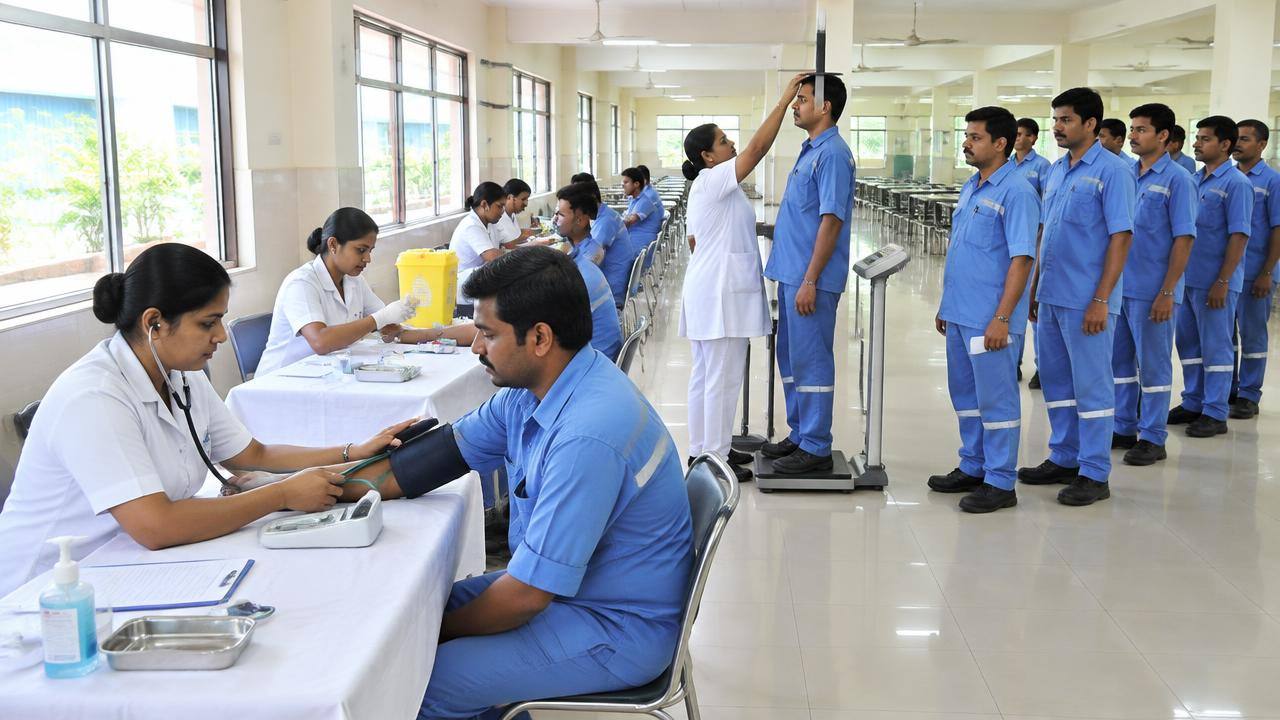
Large projects and plants often rely on contract and migrant workers who arrive in batches, change employers and live in site camps. They face higher risk from unfamiliar work, heat, crowded housing and limited access to local healthcare. Good screening and welfare protect the worker, prevent outbreaks and reduce lost time. The examining doctor (a registered medical practitioner) decides the final protocol, intervals and fitness opinion. Vaccination and infection-control decisions follow the doctor's advice and current public health guidance.
Arrival-to-exit health pathway
- 1Register workers with ID and contractor details.
- 2Pre-placement fitness review before induction to tasks.
- 3Role-based checks for height, driving, confined space and other high-risk work.
- 4Doctor-advised infection screening and vaccination where relevant.
- 5Induction on site hazards, OHC access and emergency numbers.
- 6Periodic checks and camp health visits during the project.
- 7Exit summary and report copy to the worker.
Welfare essentials
| Area | What to check |
|---|---|
| Drinking water | Verified source, clean storage, easy access at work fronts |
| Food | Hygienic kitchens, safe storage, food-handler health |
| Sanitation | Clean toilets, handwashing, drainage, menstrual hygiene |
| Housing | Ventilation, space, fire safety, pest control |
| Healthcare access | OHC hours, referral hospital, emergency transport |
| Communication | Languages, helpline, grievance route |
Infection prevention
Crowded camps can spread infections such as respiratory illness, diarrhoeal disease and vector-borne disease. Work with the doctor and local public health services on screening, vaccination and outbreak response, and link with national programmes such as TB control where relevant.
For construction sites
BOCW workers may be entitled to welfare benefits through their state welfare boards; help workers with registration where your project supports it. Re-check welfare facilities as camps expand.
For factories
Apply the same health standard to contract and permanent workers doing the same job. Include contractors in surveillance and the monthly MIS.
Legal context in India
The Occupational Safety, Health and Working Conditions Code, 2020 (OSH Code) came into force on 21 November 2025 and consolidates 13 central laws, including the Factories Act, 1948 and the Building and Other Construction Workers (BOCW) Act, 1996. Many states are still notifying their OSH Code rules, so existing State Factory Rules and BOCW State Rules remain the practical reference for many formats and norms during the transition.
Staffing levels, examination intervals, register formats and qualifications vary by state, process and workforce. Check the applicable state rules before treating any figure as a requirement. This is general information, not legal or medical advice; a registered medical practitioner decides any clinical protocol.
Plan this with Health Safety India
Health Safety India by Jainam Wellness Ltd. helps factories and construction projects plan contract and migrant worker health. Share your headcount, shifts, processes and location through the quote form, or call +91 8591983184 / 9820891087. Enquiries are accepted PAN India and local deployment is confirmed per site. Ambulance services are available in Mumbai and Pune only; in an emergency call 108 or 112.
Frequently asked questions
- Should contract workers get the same medical checks as employees?
- Workers doing the same task face the same risk; apply the same health standard through contracts.
- Which vaccinations should migrant workers get?
- That is decided by the doctor using current public health guidance and local disease patterns.
- Can workers be refused jobs after screening?
- Fitness should be about safe placement for a specific task; consider restrictions or alternative work and handle results confidentially.
- Who is responsible for contractor workers' health?
- Duties are shared between principal employer and contractor under applicable law; agree responsibilities in writing.
- How do we handle language barriers?
- Use interpreters, visual materials and bilingual staff at camps and inductions.
Talk to our occupational health and safety team
Health Safety India by Jainam Wellness Limited — onsite OHCs, safety audits, safety training, fire safety and environmental audits for PAN India enquiries; ambulances are Mumbai and Pune only. Call +91 8591983184 / 9820891087 or write to info@planmyhealth.in.
Explore the related occupational health serviceSources
- Ministry of Labour & Employment — labour codes
- International Labour Organization — OSH
- WHO — occupational health
- National TB Elimination Programme
General information, not legal or medical advice. A registered medical practitioner decides any examination protocol, and applicable rules vary by state and during the OSH Code transition.
Related workplace health and safety services
Related reading
Dust, Drinking Water, Sanitation and Labour-Camp Hygiene on Construction Sites
Read Factory & Construction SafetyHeat Stress and Monsoon Safety on Construction Sites
Read Factory & Construction SafetyConstruction site health & first aid requirements under the OSH Code
Read Occupational HealthOHC Vendor RFP & SLA Checklist for Factories and Construction Projects in India
Read