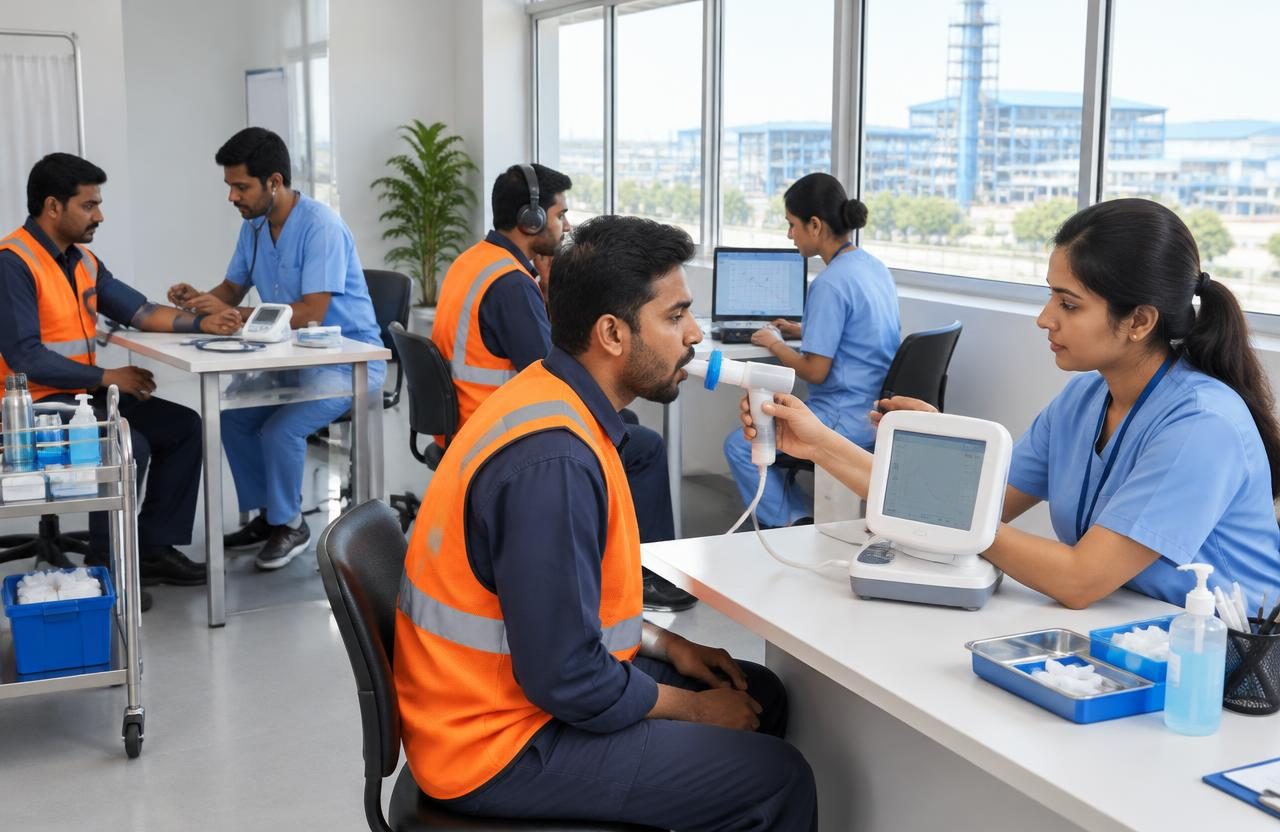
Hazard-based surveillance asks what a worker is exposed to. Role-based fitness asks a second question: can this person do this specific job safely for themselves and others? A crane operator and a canteen cook in the same factory need very different checks. This guide lists checks commonly considered for common roles and the reason for each. The examining doctor (a registered medical practitioner) decides the final protocol, intervals and fitness opinion.
Commonly considered checks by role
Use this as a planning starting point with your OHC doctor; it is not a statutory list.
| Role | Commonly considered checks | Why |
|---|---|---|
| Welder | Eye examination; respiratory review; spirometry where fume exposure is assessed | Arc light, sparks and metal fumes |
| Painter / sprayer | Skin and respiratory review; substance-specific tests if the SDS supports them | Solvents, resins and sensitisers |
| Crane / forklift operator | Vision incl. depth and field; hearing; blood pressure; neurological history | Judging distance and sudden incapacity risk |
| Driver | Vision and colour vision; blood pressure; sugar; sleep history | Road safety and alertness |
| Height worker | Balance, vertigo, blood pressure, seizure history, vision | Falls from dizziness or blackout |
| Confined-space entrant | Cardiorespiratory review; fitness to wear breathing apparatus; claustrophobia history | Heat, exertion and respirator use in tight spaces |
| Electrician | Colour vision; cardiac history | Wire colour codes; safety-critical work |
| Lab / chemical handler | Skin, eye and respiratory review; validated biological monitoring if applicable | Splash and vapour exposure |
| Food handler | Infection and skin review as per applicable food-safety requirements | Protecting consumers |
| Security guard | Vision, hearing, blood pressure; night-shift history | Observation, alarms, long shifts |
How to build role-based protocols
- 1List roles from actual job descriptions, including contractors.
- 2Mark safety-critical tasks (driving, lifting, height, confined space, electrical).
- 3Add exposures from the hazard and process map.
- 4Agree checks and intervals with the OHC doctor.
- 5Record fit, fit with restrictions, temporarily unfit or referral outcomes.
- 6Re-examine on role change, after significant illness or after an incident where relevant.
For factories
Factory roles are usually stable, so build a role-exposure matrix once and review it with each process change. Shift-based operators of cranes and forklifts are often the largest safety-critical group.
For construction sites
Construction workers often change roles across project phases. Re-check fitness when a labourer moves to height work, scaffolding, driving or confined-space entry, and examine contractor batches before induction to high-risk tasks.
Fitness outcomes and restrictions
A restriction should be practical and specific, for example 'no work at height until review' rather than a diagnosis shared with supervisors. The worker should be told the reason and the next step, and the employer should look for suitable alternative work.
Legal context in India
The Occupational Safety, Health and Working Conditions Code, 2020 (OSH Code) came into force on 21 November 2025 and consolidates 13 central laws, including the Factories Act, 1948 and the Building and Other Construction Workers (BOCW) Act, 1996. Many states are still notifying their OSH Code rules, so existing State Factory Rules and BOCW State Rules remain the practical reference for many formats and norms during the transition.
Staffing levels, examination intervals, register formats and qualifications vary by state, process and workforce. Check the applicable state rules before treating any figure as a requirement. This is general information, not legal or medical advice; a registered medical practitioner decides any clinical protocol.
Plan this with Health Safety India
Health Safety India by Jainam Wellness Ltd. helps factories and construction projects plan role-based worker medical examinations. Share your headcount, shifts, processes and location through the quote form, or call +91 8591983184 / 9820891087. Enquiries are accepted PAN India and local deployment is confirmed per site. Ambulance services are available in Mumbai and Pune only; in an emergency call 108 or 112.
Frequently asked questions
- Is there a fixed medical test list for each role in India?
- No universal list exists. Applicable rules, the process and the OHC doctor determine the protocol.
- Do forklift operators need an eye test?
- Vision is commonly assessed for operators because judging distance and seeing pedestrians is essential.
- Should welders get spirometry?
- It is commonly considered where fume exposure is assessed as significant; the doctor decides.
- Do contractors need role-based fitness checks?
- Contractors doing safety-critical or exposed tasks face the same risks and should be covered by agreed arrangements.
- When should a worker be re-examined?
- At the interval the doctor or rules set, and on role change, after serious illness or after relevant incidents.
Talk to our occupational health and safety team
Health Safety India by Jainam Wellness Limited — onsite OHCs, safety audits, safety training, fire safety and environmental audits for PAN India enquiries; ambulances are Mumbai and Pune only. Call +91 8591983184 / 9820891087 or write to info@planmyhealth.in.
Explore the related occupational health serviceSources
- Ministry of Labour & Employment — labour codes
- ICMR-National Institute of Occupational Health
- DGFASLI — occupational safety and health
- NIOSH (CDC) — workplace safety and health
General information, not legal or medical advice. A registered medical practitioner decides any examination protocol, and applicable rules vary by state and during the OSH Code transition.
Related workplace health and safety services
Related reading
Fitness for Work at Height and in Confined Spaces: What Is Assessed and Why
Read Occupational HealthHazardous process industries: health surveillance checklist
Read Occupational HealthPre-employment, periodic and exit medical examinations: the complete protocol
Read Occupational HealthOHC Vendor RFP & SLA Checklist for Factories and Construction Projects in India
Read