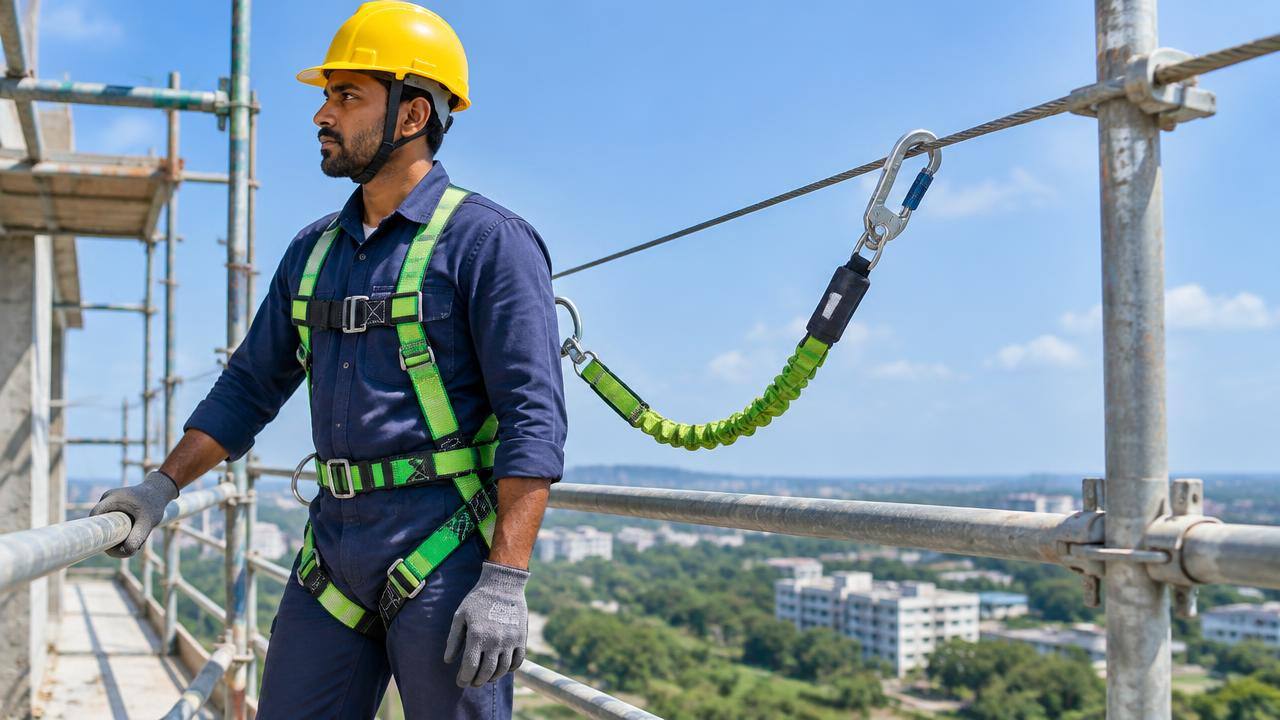
Falls from height and confined-space incidents are among the most serious risks on Indian factory and construction sites. Engineering controls, permits and rescue plans come first, but a worker who is prone to dizziness, blackouts or panic adds risk that equipment cannot remove. A fitness assessment helps place the right people in these tasks. It does not certify that the job is safe. The examining doctor (a registered medical practitioner) decides the final protocol, intervals and fitness opinion.
What is commonly assessed
| Area | Height work | Confined space | Why |
|---|---|---|---|
| History | Fainting, seizures, vertigo, fear of heights | Claustrophobia, asthma, heart disease | Sudden incapacity or panic |
| Vision | Acuity and depth judgement | Acuity | Footing and hazard recognition |
| Blood pressure and heart | Yes | Yes, with exertion and heat in mind | Collapse risk |
| Balance / ENT | Yes | Relevant | Stable footing |
| Breathing | General | Respiratory review; fitness to wear breathing apparatus | Respirator use in tight spaces |
| Musculoskeletal | Climbing, gripping, harness use | Crawling, kneeling, rescue position | Physical demands |
| Medicines / alcohol | Sedating medicines | Sedating medicines | Alertness |
Steps to set up the assessment
- 1Identify every task that involves height or confined-space entry.
- 2Write a short task description for the doctor (heights, duration, PPE, breathing apparatus).
- 3Agree the assessment content and review interval with the doctor.
- 4Issue a role-specific fitness opinion with any restrictions.
- 5Link fitness status to the permit-to-work system so unfit workers are not issued permits.
- 6Re-assess after illness, injury, new medicines or an incident.
For factories
Maintenance teams, tank cleaners and roof workers are the usual groups. Keep fitness status visible to permit issuers without disclosing medical details.
For construction sites
Scaffolders, steel fixers, facade, tower crane and shaft workers rotate often. Examine before induction to height tasks and repeat checks for long projects as advised by the doctor. Heat on exposed structures adds risk in summer.
What fitness checks cannot do
- They cannot make an unsafe edge or atmosphere safe
- They cannot predict every collapse
- They do not replace gas testing, ventilation and standby rescue
- They do not replace harness inspection and training
Legal context in India
The Occupational Safety, Health and Working Conditions Code, 2020 (OSH Code) came into force on 21 November 2025 and consolidates 13 central laws, including the Factories Act, 1948 and the Building and Other Construction Workers (BOCW) Act, 1996. Many states are still notifying their OSH Code rules, so existing State Factory Rules and BOCW State Rules remain the practical reference for many formats and norms during the transition.
Staffing levels, examination intervals, register formats and qualifications vary by state, process and workforce. Check the applicable state rules before treating any figure as a requirement. This is general information, not legal or medical advice; a registered medical practitioner decides any clinical protocol.
Plan this with Health Safety India
Health Safety India by Jainam Wellness Ltd. helps factories and construction projects plan fitness assessments for height and confined-space work. Share your headcount, shifts, processes and location through the quote form, or call +91 8591983184 / 9820891087. Enquiries are accepted PAN India and local deployment is confirmed per site. Ambulance services are available in Mumbai and Pune only; in an emergency call 108 or 112.
Frequently asked questions
- Is a height fitness certificate legally required?
- Requirements vary by state rules and contracts; many principal employers require it as a site condition.
- Can a worker with high blood pressure work at height?
- That is a clinical decision for the doctor based on control, symptoms and the task.
- Does confined-space fitness include a lung test?
- A respiratory review is common; spirometry may be considered where the doctor feels it adds value.
- How long is a fitness opinion valid?
- For the interval the doctor sets, or until health, medicines or the task change.
- Should supervisors know the diagnosis?
- No. Supervisors need the fitness outcome and any restriction, not medical details.
Talk to our occupational health and safety team
Health Safety India by Jainam Wellness Limited — onsite OHCs, safety audits, safety training, fire safety and environmental audits for PAN India enquiries; ambulances are Mumbai and Pune only. Call +91 8591983184 / 9820891087 or write to info@planmyhealth.in.
Explore the related occupational health serviceSources
- Ministry of Labour & Employment — labour codes
- NIOSH (CDC) — workplace safety and health
- International Labour Organization — OSH
- DGFASLI — occupational safety and health
General information, not legal or medical advice. A registered medical practitioner decides any examination protocol, and applicable rules vary by state and during the OSH Code transition.
Related workplace health and safety services
Related reading
Medical Tests by Job Role: Welders, Drivers, Height Workers and More
Read Accident PreventionPermit-to-Work: Height, Hot Work, Confined Space, Excavation and Electrical Isolation
Read Factory & Construction SafetyConstruction site health & first aid requirements under the OSH Code
Read Occupational HealthOHC Vendor RFP & SLA Checklist for Factories and Construction Projects in India
Read