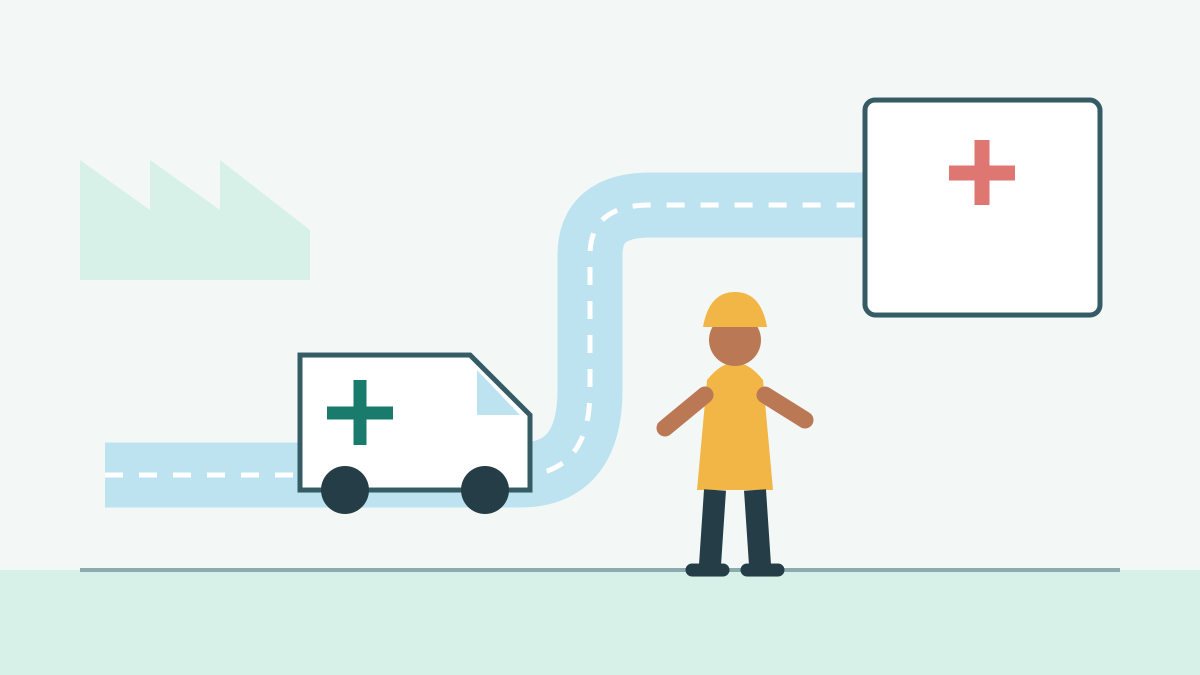
Construction emergency readiness depends on reaching a patient safely and handing care to a capable receiving team. A practical drill tests access, communication and referral arrangements without promising a response time that the site has never measured.
Define a safe, realistic drill objective
Choose a scenario from the site’s risk assessment, such as an injury at a changing work front or a worker needing urgent medical referral. Identify what the exercise will test: alarm activation, location information, safe access, patient transfer, gate clearance or hospital communication. Separate the exercise from real rescue operations.
Use a planned simulated casualty and competent supervision. Do not expose participants to height, confined spaces, electrical hazards or unsafe lifting for realism. Obtain site permission and inform relevant teams so the drill is not mistaken for an actual emergency. Keep a clear stop instruction and allow a real emergency to override the exercise.
Match transport planning to clinical needs
Have a competent clinical reviewer help assess likely emergencies, initial care capability, patient movement and the appropriate transport category. An ALS label alone does not establish the required crew, equipment or safe operating capability. Check vehicle suitability, maintenance, equipment function, consumables and professional competence against the proposed scope and applicable requirements.
Health Safety India accepts onsite ALS/BLS ambulance service enquiries for Mumbai and Pune only, with vehicle and crew arrangements confirmed in the proposal. For projects elsewhere, verify qualified local third parties and receiving facilities independently. Do not describe pan-India medical staffing enquiries as nationwide ambulance availability or a fleet in every city.
Walk the patient-to-vehicle route
Map access from each significant work front to the pickup point. Check temporary roads, turning space, gradients, gates, pedestrian conflicts, overhead restrictions and stretcher movement. Include night lighting, monsoon conditions and delivery congestion. A clear main entrance does not prove that an ambulance can reach a remote excavation or upper-level work area.
Where specialist rescue is needed, use the site rescue plan and competent personnel; the clinic team cannot safely improvise every extraction. Identify areas where work restrictions or additional controls are needed until access is improved. Mark the meeting point in language and formats understood by security, contractors and responders.
Confirm hospitals by capability, not distance
Discuss referral arrangements with receiving facilities and confirm the communication process. Different incidents may require trauma, burns, cardiac, ophthalmic or other specialist capability. The nearest building labelled hospital may not provide the needed service at the relevant time. Keep alternative pathways when admission or a specialist service is unavailable.
A referral letter or displayed hospital name is not a guarantee of acceptance. Reconfirm contacts, access and operational arrangements periodically and after major changes. Do not call emergency departments for a simulated admission unless the exercise has been coordinated with them. Use a designated simulation contact where real services must remain undisturbed.
Rehearse communication and clinical handover
Test whether callers can give the exact work-front location, hazard status, patient condition as assessed by trained staff and safe access instructions. Assign who meets the vehicle, controls the gate and contacts the receiving facility. Provide language support where needed and test an alternative communication channel if radios or phones fail.
Clinical handover should communicate relevant observations, care already provided and referral concerns within professional scope. Protect identity and medical details from general radio traffic and public messaging groups. Use fictional details in training records. Workers should know the real emergency escalation pathway, including 108 or 112 for public emergencies.
Record observations without inventing benchmarks
Record what actually happened, including blocked access, misunderstood location messages, unavailable contacts and equipment problems. If timings are measured, define the start and end points and note conditions. A drill result is a scenario observation, not a guaranteed future response time or a marketing claim.
Agree improvements from the evidence. A delay may require a road change, security procedure, staffing review or a different referral arrangement, not simply faster driving. Do not reward unsafe speed or hurried patient movement. Keep the drill worksheet distinct from identifiable patient care records.
| Stage | Observe | Action owner |
|---|---|---|
| Alert | Was location and hazard information understood? | Site coordinator |
| Access | Could responders reach the simulated casualty safely? | Construction manager |
| Transfer | Was movement supervised and equipment suitable? | Clinical and rescue leads |
| Referral | Was the agreed communication pathway available? | Clinic coordinator |
| Debrief | Were gaps assigned and verified? | Project manager |
Include visitors, contractors and temporary access restrictions
Ask whether a new subcontractor, visiting engineer or delivery driver would understand the alarm and meeting-point instructions. Temporary workers may not recognise building numbers used by permanent staff. Check signs against actual routes and explain access restrictions at induction. If a road closes for lifting or concrete delivery, communicate the alternative before work begins and verify it remains suitable for emergency access. Do not assume responders can bypass a controlled lifting zone. Incorporate these conditions into the drill debrief and ensure the relevant construction supervisor owns the correction. Accessible communication matters as much as a route drawn on a plan.
Close actions before the next project phase
Debrief with clinic staff, security, supervisors, contractors and relevant transport personnel. Invite workers to explain confusion rather than assign blame immediately. Record interim controls and corrective actions with owners and due dates. Verify improvements at the affected work front, not only on the updated emergency plan.
Repeat selected checks after road changes, new contractors, shift changes or relocation of the site clinic. Choose exercise frequency using risk and applicable requirements, not an invented national schedule. Request Mumbai/Pune ambulance standby scope or construction clinic planning separately, and make all local arrangements explicit before mobilisation.
Frequently asked questions
- Does every construction site need an ALS ambulance?
- No blanket requirement is asserted here. Applicable rules, site risks and clinician-informed transport needs determine the arrangement.
- Can Health Safety India provide an ambulance anywhere in India?
- Its stated ambulance offer is Mumbai and Pune only. Other locations require independently verified qualified local providers.
- Should we publish the drill’s fastest time?
- Do not treat one exercise as a future guarantee. Review defined timings alongside safety, conditions and corrective actions.
Talk to our occupational health and safety team
Health Safety India by Jainam Wellness Limited — onsite OHCs, safety audits, safety training, fire safety and environmental audits for PAN India enquiries; ambulances are Mumbai and Pune only. Call +91 8591983184 / 9820891087 or write to info@planmyhealth.in.
Explore the related occupational health serviceSources
- MoRTH: vehicle standards and transport resources
- Ministry of Labour: OSH Code and implementation resources
General information, not legal or medical advice. A registered medical practitioner decides any examination protocol, and applicable rules vary by state and during the OSH Code transition.
Related workplace health and safety services
Related reading
OHC Vendor RFP & SLA Checklist for Factories and Construction Projects in India
Read Occupational HealthAFIH/MBBS Doctor and Industrial Nurse Shift Roster Planning for Factory OHCs
Read Environment & HealthBiomedical Waste Handover, Records and CBWTF Coordination for Factory Site Clinics
Read Safety AuditEHS, HSE and Environmental Audit: Corrective Action Closure Tracker for Industrial Projects
Read