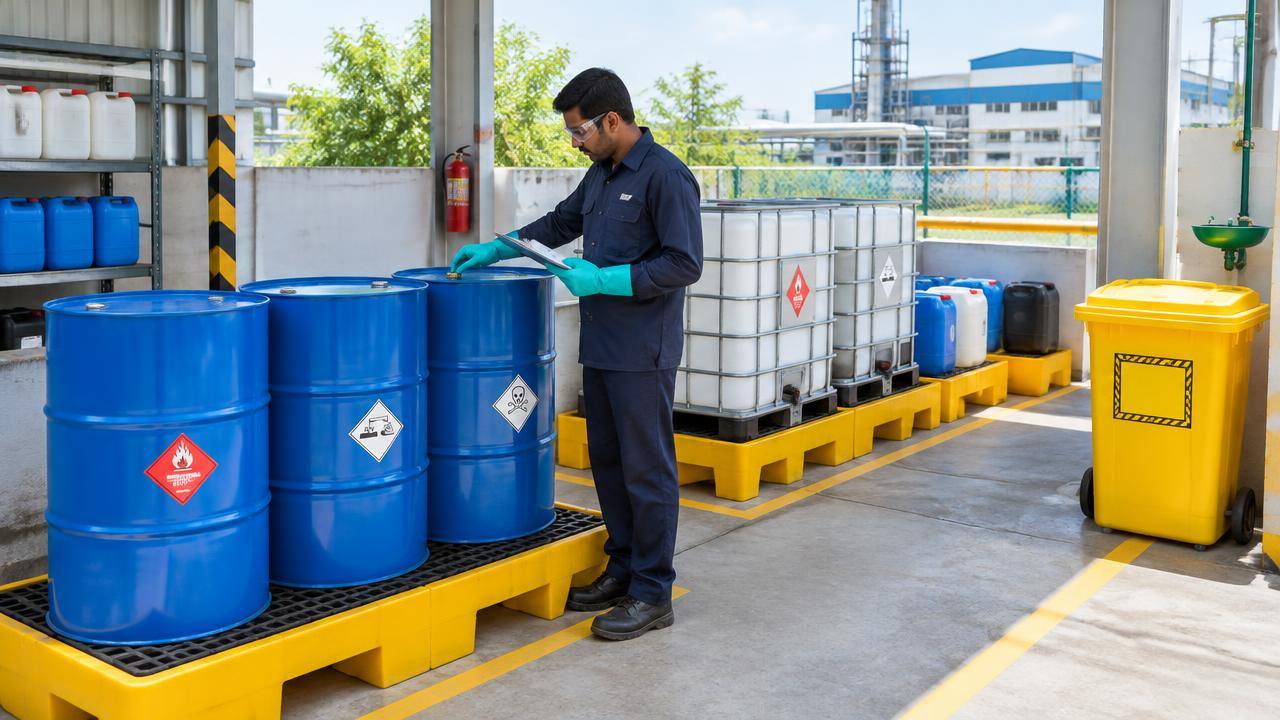
Every hazardous chemical on site should have a current safety data sheet (SDS, formerly MSDS) that workers can access and understand. The SDS tells you hazards, safe handling, storage, PPE, first aid and spill response. Good chemical management combines an inventory, safe storage, trained handlers, emergency readiness and health surveillance where exposure is significant. Specific hazardous-chemical rules apply to some sites; check what applies.
Key SDS sections to use
| SDS section | Use it for |
|---|---|
| Hazards identification | Training and labels |
| First-aid measures | OHC and first-aider preparation |
| Fire-fighting measures | Emergency plan and extinguisher choice |
| Accidental release measures | Spill procedures |
| Handling and storage | Storage layout and compatibility |
| Exposure controls / PPE | Engineering controls and PPE selection |
| Toxicological information | Doctor's surveillance planning |
Spill response steps
- 1Raise the alarm and keep people away.
- 2Check the SDS for hazards and PPE.
- 3Stop the source if safe to do so.
- 4Contain with absorbents or bunds; protect drains.
- 5Clean up with trained staff and the right PPE.
- 6Dispose of waste through an authorised route.
- 7Give first aid and seek medical care for exposed people.
- 8Report and investigate.
For factories
Review the inventory whenever purchasing adds a new chemical, and send the SDS to the OHC so the doctor can review whether surveillance is needed.
For construction sites
Paints, solvents, adhesives, waterproofing chemicals and fuels are common. Keep a small labelled store with spill kit and SDS file, and include chemicals in induction for the crews using them.
Legal context in India
The Occupational Safety, Health and Working Conditions Code, 2020 (OSH Code) came into force on 21 November 2025 and consolidates 13 central laws, including the Factories Act, 1948 and the Building and Other Construction Workers (BOCW) Act, 1996. Many states are still notifying their OSH Code rules, so existing State Factory Rules and BOCW State Rules remain the practical reference for many formats and norms during the transition.
Staffing levels, examination intervals, register formats and qualifications vary by state, process and workforce. Check the applicable state rules before treating any figure as a requirement. This is general information, not legal or medical advice; a registered medical practitioner decides any clinical protocol.
Plan this with Health Safety India
Health Safety India by Jainam Wellness Ltd. helps factories and construction projects plan chemical safety and spill response. Share your headcount, shifts, processes and location through the quote form, or call +91 8591983184 / 9820891087. Enquiries are accepted PAN India and local deployment is confirmed per site. Ambulance services are available in Mumbai and Pune only; in an emergency call 108 or 112.
Frequently asked questions
- Is an SDS the same as an MSDS?
- Yes; SDS is the current name for the material safety data sheet.
- Must SDS be in the local language?
- Workers must understand the information; provide summaries in their language.
- Who needs chemical health surveillance?
- Workers with significant exposure, as decided by the doctor using the SDS and exposure data.
- What should a spill kit contain?
- Absorbents, PPE, bags and tools suited to the chemicals on site, per their SDS.
- How is chemical waste disposed of?
- Through authorised hazardous-waste routes as required by applicable rules.
Talk to our occupational health and safety team
Health Safety India by Jainam Wellness Limited — onsite OHCs, safety audits, safety training, fire safety and environmental audits for PAN India enquiries; ambulances are Mumbai and Pune only. Call +91 8591983184 / 9820891087 or write to info@planmyhealth.in.
Explore the related occupational health serviceSources
- Ministry of Labour & Employment — labour codes
- Central Pollution Control Board
- NIOSH (CDC) — workplace safety and health
- International Labour Organization — OSH
General information, not legal or medical advice. A registered medical practitioner decides any examination protocol, and applicable rules vary by state and during the OSH Code transition.
Related workplace health and safety services
Related reading
PPE Selection by Hazard and How It Links to Health Surveillance
Read Occupational HealthHazardous process industries: health surveillance checklist
Read Environment & HealthWorkplace Environment Monitoring: Noise, Light, Ventilation, Heat and Air Quality
Read Occupational HealthOHC Vendor RFP & SLA Checklist for Factories and Construction Projects in India
Read